Legislative elections in Israel: Presidential consultations this Wednesday, November 4, the Electoral Commission finds no evidence of fraud in the legislative elections.
The Israeli Electoral Commission announced on Wednesday that it found no evidence of fraud affecting the integrity of the recent legislative elections, the results of which are contested by the camp of outgoing Prime Minister Benjamin Netanyahu. President Herzog will receive the official results on November 4 at noon and will begin hearings at 5 PM, starting with the smaller lists.
Published on 4 November 2026
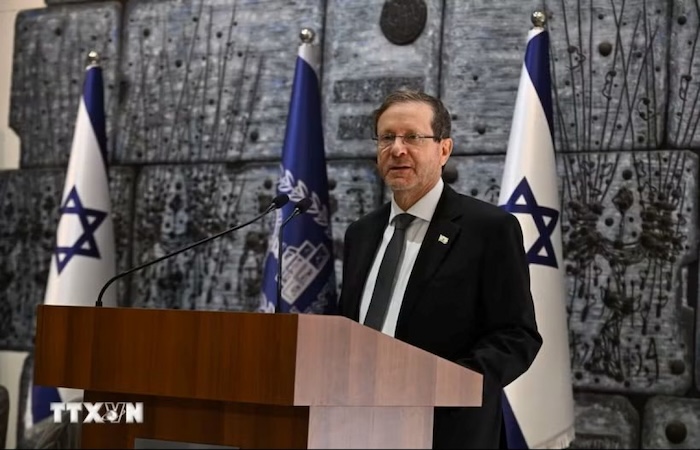
President Herzog, whose role remains largely ceremonial outside of government formation periods, thus finds himself at the center of the negotiations.
On Wednesday, the Israeli Electoral Commission dismissed allegations of fraud in the legislative elections, contested by Benjamin Netanyahu’s party. After examining the appeals filed by various parties and conducting thorough checks, the electoral authorities found “no irregularities or evidence indicating that the integrity of the elections was compromised or that the results were altered,” the commission stated in a press release.
This clarification comes just hours before the publication of the official results of this election, which did not yield any majority.
Things to discover
Presidential consultations on Wednesday, November 4, to break the post-electoral deadlock. No camp having obtained an absolute majority following the legislative elections of October 27, 2026, President Isaac Herzog opened a series of consultations on Wednesday, November 4, aimed at designating the deputy responsible for forming the next government.
The unusual order from the smallest parties to the largest reflects the desire to explore all possible combinations before any potential new elections. According to the final count, Benjamin Netanyahu’s bloc holds 53 seats out of the 120 in the Knesset (Likud 27, Otzma Yehudit 7, United Torah Judaism 7, Shas 6, Religious Zionism-Zehut 6).
The “Zionist” opposition led by Gadi Eisenkot (Yashar) has 48 seats (Yashar 21, B’Yachad 12, Democrats 8, Yisrael Beiteinu 7). The Arab parties reached 19 seats (Unified List 11, Ra’am 8), an unprecedented level. Voter turnout was around 78%. No clear majority of 61 seats emerges, even though the forces opposed to Netanyahu total 67 deputies.
President Herzog will receive the official results on November 4 at noon and will begin hearings at 5 PM, starting with the smaller lists.
On Wednesday evening, Religious Zionism-Zehut, Shas, and Yisrael Beiteinu will be heard; on Thursday, United Torah Judaism, Otzma Yehudit, the Democrats, Ra’am, the Unified List, B’Yachad, Yashar, and finally, Likud will follow. President Herzog has called on political leaders to show “open-mindedness” and to “come down from the trees” to avoid another election.
The mechanism is set by the fundamental law on government. After the consultations, the president charges the deputy he deems best placed to form a coalition. This deputy has 28 days, extendable by 14, to gain the confidence of the Knesset. In case of failure, a second candidate can be designated, and then, as a last resort, 61 deputies can propose a personality for a final 14-day attempt.
If no solution is reached, the Knesset is automatically dissolved, and new elections are called within approximately 90 days. The new assembly will be sworn in on November 10, regardless of the outcome of the negotiations.
The Knesset, mostly opposed to Netanyahu
The opposition is leaning towards a unanimous recommendation in favor of Eisenkot. The Arab parties could provide him with the same support, bringing his total to 67 recommendations against 53 for Netanyahu, but hesitations persist within Eisenkot’s camp, particularly from Avigdor Lieberman, regarding the possibility of a minority government supported externally by Ra’am or the Unified List. Eisenkot himself has set preconditions for recognition of Israel as a Jewish and democratic state, service for all, and classifying Hamas as a terrorist organization, complicating the equations.
Herzog, whose role remains largely ceremonial outside of government formation periods, thus finds himself at the center of the negotiations. His invitation for “creative solutions” suggests the possibility of a unity government or a broad arrangement, even if the ideological, personal, and post-October 7, 2023 divides remain pronounced.
The Knesset, mostly opposed to Netanyahu, could also influence the timing and institutional balances.
The immediate challenge is to end a transitional situation in which Netanyahu remains interim Prime Minister, while avoiding a new electoral cycle in an already deeply polarized country.
The coming days, as hearings take place at the presidential residence, will reveal whether the actors favor a fragile compromise or a new trip to the polls.
The editorial team recommends
- Legislative elections in Israel: neither the Netanyahu nor the Eisenkot blocs have a majority, the Arab parties in a position of “kingmakers”
- The Israeli electoral system: how it works
- October 7: three years later, we do not forget
- October 7, 2023: bare barbarism and absolute hatred of the other
Fancy reading all the articles?
Unlock all articles straight away. No obligation.