Israel: the Eisenkot camp wins the presidency of the Knesset with 66 votes, a setback for the Netanyahu camp
Matan Kahana, a member of the Yashar! party and a former Israeli special forces operative close to Gadi Eisenkot, was elected on November 17 to head the Knesset, notably with the support of the Arab parties.
Published on 19 November 2026
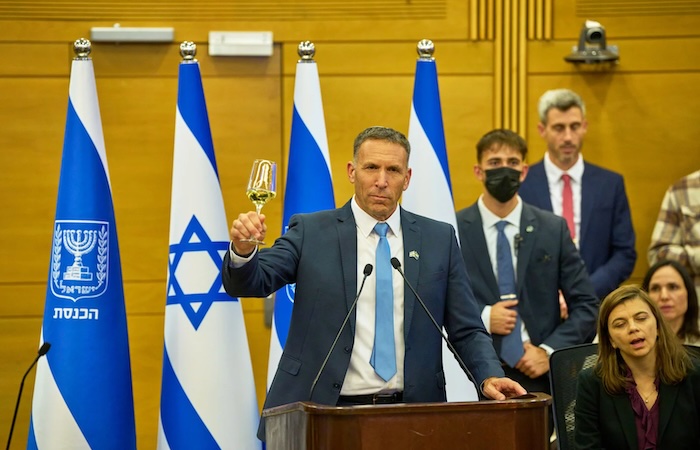
Matan Kahana, a member of the Yashar! party led by Gadi Eisenkot, was elected president of the Knesset on Tuesday evening with 66 votes, succeeding Amir Ghana of Likud.
On November 17, 2026, the Knesset elected Matan Kahana, a member of the centrist Yashar party led by Gadi Eisenkot, as its president with 66 votes against 52 for Ofir Katz (Likud). His election, made possible by the support of the change bloc and the Arab parties, marks a new political setback for Benjamin Netanyahu’s camp, now deprived of the presidency of the Parliament.
Things to discover
This vote, which came after six hours of parliamentary obstruction from Benjamin Netanyahu’s camp, gives the opposition bloc control of the legislative agenda, while negotiations to form a government continue after the October 27 elections, which did not yield a majority.
“A new chapter opens for the Knesset,” which “will fully and effectively play its role as a controlling body” of the government, reacted Mr. Eisenkot on X.
מברך את ח״כ מתן כהנא, שותפי לדרך, יושב ראש הכנסת הנבחר. פרק חדש מתחיל 🇮🇱 תחת מתן הכנסת תחזור להיות בית העם- של כל העם, בו יש אוזן קשבת ויחס שווה לכל חלקי החברה ונציגיהם. פרק חדש נפתח עבור כנסת ישראל. זה יהיה פרק של ממלכתיות, שיח מכבד וענייני ושל מילוי תפקידה של הכנסת כגוף פיקוח אפקטיבי וחזק – תפקיד חשוב וקריטי בימים רגישים אלו. מתן – אני גאה בך ובטוח בהצלחתך.
— Gadi Eisenkot – גדי איזנקוט (@gadi_eisenkot) November 17, 2026
The legislative elections of October 27 produced a fragmented Knesset. Netanyahu’s right and far-right bloc secured 53 seats out of 120 (Likud with 27, the largest party), while the opposition bloc led by Eisenkot (Yashar 21, B’Yachad of Naftali Bennett 12, the Democrats of Yaïr Golan 8, and Yisrael Beytenu of Avigdor Liberman 7) gathered 48 seats, and the two Arab lists (United List and Raam) made a historic breakthrough with 19 seats, a record.
Voter turnout reached 77.9%, its highest level in decades. No camp achieved the majority of 61 seats required to govern.
On November 8, President Isaac Herzog entrusted Eisenkot with the mandate to form a government, after factions representing 67 deputies recommended him (against 46 for Netanyahu). Eisenkot initially has 28 days (until December 6), extendable by 14 days.
In the meantime, Netanyahu remains the acting Prime Minister. The new Knesset was sworn in on November 10.
The role of the president of the Parliament is important as it sets the schedule for parliamentary activities
The vote for the presidency took place in two separate ballots. Kahana received the support of the four parties in the Eisenkot bloc and the two Arab parties (with one absence). Katz garnered the support of 52 of the 53 deputies from the Netanyahu bloc. The handover of power with Amir Ohana (Likud), the outgoing president since 2022, was formal, with Ohana handing the gavel to his successor.
In his inaugural speech, Kahana stated: “The Knesset of Israel is the home of all citizens of the State of Israel, and I intend to be the president for each of them, without distinction of religion, race, or gender.”
He also asserted that under his presidency, the Knesset would fully comply with the decisions of the Supreme Court in reference to past tensions surrounding judicial reform. Nine vice-presidents were then elected, including two Arab deputies (Ahmad Tibi and Walid Taha).
At 54 years old, born on July 29, 1972, in Haifa, Kahana is a former colonel in the Israeli Air Force, an F-16 pilot, and a former member of the elite unit Sayeret Matkal. He served as Minister of Religious Services in Naftali Bennett’s government (2021-2022), where he led reforms aimed at limiting the monopoly of the Chief Rabbinate. A practicing Jew with a religious Zionist orientation, he joined Eisenkot’s Yashar party.
Powers and implications
The president of the Knesset leads the presidium with the vice-presidents and sets the agenda for the plenary session by approving parliamentary work, including parliamentary initiative bills. This position confers significant influence over the legislative calendar, even in the absence of a fully constituted government.
The Eisenkot bloc plans to use this position to advance texts aimed at repealing elements of the judicial reform of the previous legislature and to create a state inquiry commission into the failures of October 7, 2023.
Agreements have postponed some advancements to the following week to end the obstruction. Control of key committees on finance, foreign affairs, and defense strengthens this oversight capacity over Netanyahu’s acting government.
This election represents an initial institutional success for Eisenkot, but the formation of a government remains uncertain. His bloc of 48 Jewish seats needs additional support, potentially including Arab parties, whose integration into a coalition is politically sensitive for several partners.
Netanyahu retains executive levers as acting Prime Minister. Negotiations continue under the watch of political actors and Israeli society, in a context marked by the aftermath of October 7 and divisions over judicial reform.
The coming days and weeks will determine whether this control of the Knesset will translate into concrete legislative advancements or remain a temporary lever while awaiting a coalition solution.
The editorial team recommends
- The European Union is expanding its sanctions against the financing of Hamas by targeting Gaza Now and its founder.
- October 7: three years later, we do not forget
- October 7, 2023: bare barbarism and absolute hatred of the other
Fancy reading all the articles?
Unlock all articles straight away. No obligation.