Commemoration of November 13, 2015: the shock of memory that the ritualized tribute denies us
November 13, 2015, was not an act of abstract violence; it was a coordinated operation by the Islamic State, carried out by commandos who had precisely chosen their targets: a football match, crowded café and restaurant terraces, and a concert hall.
Published on 13 November 2026
Paying tribute to the victims is a duty, but the risk is that it becomes a ritual that allows for a lack of clarity.
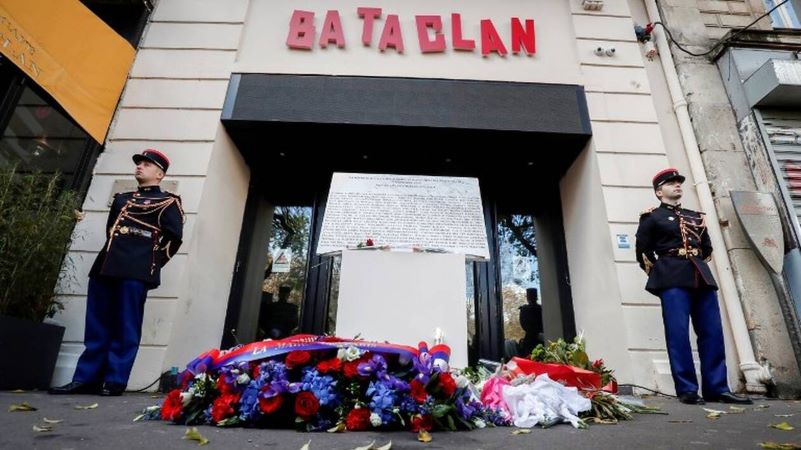
Eleven years later, the plaques are there, the moments of silence too, flowers in front of the Bataclan and the terraces. We read the names, we talk about resilience, about music being stronger than bullets, about life resuming; this is necessary. But it is no longer enough; a tribute that merely comforts and never forgets the victims, without clearly naming what killed them or measuring what continues, ultimately leads to forgetfulness.
We need a shock of memory, not another ceremony. November 13, 2015, was not an act of abstract violence; it was a coordinated operation by the Islamic State, carried out by commandos who had precisely chosen their targets: a football match, crowded café and restaurant terraces, and a concert hall. At the Bataclan, 90 people were murdered during a concert by the Eagles of Death Metal. The total toll was 130 dead that night (132 counting subsequent suicides), hundreds injured. The objective was not only to kill but to strike at the ordinary way of life of the French, to terrorize civil society, to provoke fractures; Daesh claimed it as such.
The commemorations of the tenth anniversary in 2025 were dignified and filled with emotion. They also illustrated the shift. There was much talk of resilience, of living together, of music and light. A memorial garden was inaugurated. Emmanuel Macron recalled the thwarted attacks; all of this is just. But the dominant narrative tends to dilute the nature of the attack in a surge of abstract brotherhood; we honor the dead while too often avoiding naming the ideology that designated them as enemies: jihadism. We transform a political massacre into a generic human tragedy. This is how memory dulls.
The threat has not disappeared; it has mutated. The National Anti-Terrorism Prosecutor’s Office states clearly that the main threat remains jihadist. Since the establishment of the National Anti-Terrorism Prosecutor’s Office in 2019, out of 681 procedures, 480 concern jihadism. In 2025, about 87% of new procedures fell under this movement; dozens of plots have been thwarted since 2015 (nearly 80 already recorded at the beginning of 2025, and others since). The profiles have evolved, with fewer commandos projected from the Levant, more radicalized youth, sometimes minors, shaped by social networks, in what Gilles Kepel calls an “atmospheric jihadism.”
Knife attacks have still killed and injured in 2025. Services remain on permanent alert. The cultural battle is also played out elsewhere: self-censorship in schools, separatism, pressure on teachers, contestation of republican values in certain neighborhoods and on certain campuses.
Paying tribute to the victims is a duty, but the risk is that it becomes a ritual that allows for a lack of clarity. One can light candles while simultaneously refusing to see that the ideology that armed the killers of the Bataclan continues to recruit, justify violence, and seek to impose its norms. One can talk about resilience while turning a blind eye to the repeated failures of integration, to the networks, to the prisons, to the discourses that relativize or divert attention.
A shock of memory means remembering that these people died because they were French, because they lived freely, because they were on a terrace or in a concert hall on a Friday night. It means recognizing that the enemy has not laid down their arms; they have only changed their methods. Finally, it means refusing to let commemoration serve as an alibi for blindness.
Eleven years later, the threat is still at our doors; the tribute must not obscure it.
Fancy reading all the articles?
Unlock all articles straight away. No obligation.