Western Sahara: Due to a lack of agreement in the Security Council, MINURSO has been dismantled and the situation on the ground remains more than uncertain.
As his mandate expires this Saturday, two successive resolutions failed to secure the necessary votes for the renewal of the United Nations Mission for the Organization of a Referendum in Western Sahara (Minurso). Rabat demands his immediate departure. It remains to be seen who will now monitor the ceasefire.
By the correspondent of Rupture in Algiers Yacine Aït Ouffella
Published on 1 November 2026
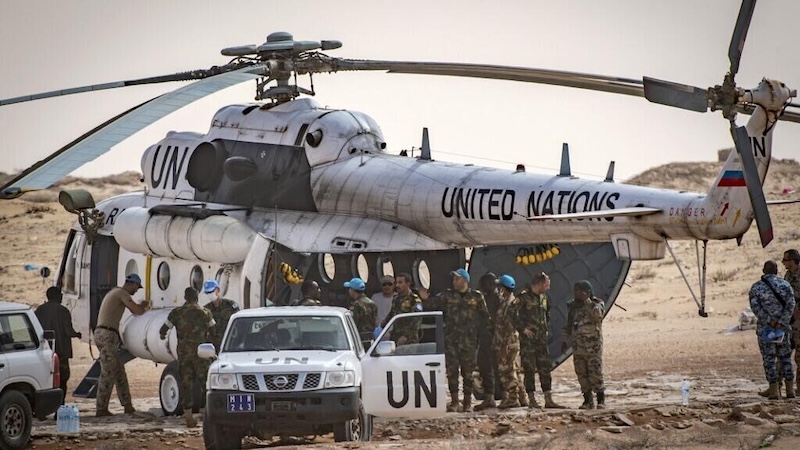
Members of the United Nations Mission for the Organization of a Referendum in Western Sahara (Minurso).
On October 30, 2026, Russia vetoed a resolution at the UN Security Council concerning Western Sahara, led by the United States. This historic blockage resulted, for the first time in 35 years, in the non-renewal of the MINURSO mandate (United Nations Mission for the Organization of a Referendum in Western Sahara). Moscow rejected the American text, denouncing a “unilateral approach.”
Things to discover
The American project, which aimed to alter the nature of the mandate of the United Nations Mission for the Organization of a Referendum in Western Sahara (MINURSO) and impose a preconceived political formula to the detriment of the Sahrawi people’s inalienable right to self-determination, could not be adopted.
During the voting session held on Friday, October 30, in New York, Russia voted against, while China, Pakistan, and Somalia abstained, illustrating a clear rupture within the international body in the face of attempts to undermine the founding principles of the United Nations Charter.
In its explanation of the vote, the Permanent Representation of the Russian Federation condemned a unilateral approach seeking to impose predetermined parameters on negotiations while ignoring the international legitimacy of the right of peoples to self-determination.
Moscow reaffirmed that no just, sustainable, and mutually acceptable solution could be reached outside the strict respect of the UN decolonization doctrine and the resolutions establishing the choice of the Sahrawi people through a free and fair referendum.
Diplomatic Deadlock at the Security Council
For observers, the exercise of the Russian veto constitutes a halt to attempts to endorse the colonial status quo or divert the Western Sahara issue from its original legal trajectory: that of a decolonization question on the agenda of the UN’s Fourth Committee.
This diplomatic deadlock at the Security Council brings to the forefront the urgent need to return to the foundations of international law and ensure the effective respect of the sovereign will of the Sahrawi people.
China also deemed that certain provisions imposed a result on one of the parties, without sufficiently balanced consultations. Several delegations reminded that the right to self-determination must remain at the heart of the settlement.
In a comment dated November 1, the spokesperson for the Russian Ministry of Foreign Affairs, Maria Zakharova, detailed Russia’s argumentation. According to Moscow, Washington sought to artificially accelerate the resolution of the issue, while no consensus exists on a definitive solution and insisted, on the eve of the deadline, to drastically reduce the mission’s prerogatives, even to renounce the organization of a referendum.
For the Russians, this approach ignored that the directly concerned parties, notably Morocco and Algeria, agree on the importance of allowing the population to determine its own destiny, especially since the United States opposed the renewal of the existing mandate, which places the mission on the brink of elimination.
Washington, according to him, wanted to reduce the role of “pen holder” to a “mere privilege devoid of any responsibility.” However, he continues, this responsibility requires “earning the trust” of the opposing party, namely the Polisario Front, as well as that of the two neighboring observer states, Algeria and Mauritania.
The UN Acknowledges the “Liquidation” of Minurso
After 35 years of presence, Minurso (United Nations Mission for the Organization of a Referendum in Western Sahara) ceases its operations following the non-renewal of its mandate by the Security Council. A liquidation period began on November 1, 2026, announces a statement from the spokesperson for the UN Secretary-General, Stéphane Dujarric. This phase is intended to organize the repatriation of equipment and settle the fate of the Mission’s assets.
For the first time since 1991, Minurso, the UN mission in Western Sahara, no longer has a mandate after the one that expired on Saturday, October 31. The day before, the Security Council rejected two rival texts.
First, the American project renamed the mission “Minuso,” without the R for referendum. It also made autonomy under Moroccan sovereignty the sole basis for negotiation. Eleven votes in favor, but a Russian veto.
Then, the counter-proposal from Moscow for a simple one-year extension of the existing mandate received only three favorable votes and this time, the American veto.
Rabat did not wait to react. In the evening, the royal cabinet demanded the departure “in the coming days” of personnel, vehicles, equipment, and symbols of the mission. No more Minurso, no more reports from the Secretary-General, no more item on the Security Council agenda.
The withdrawal, however, still needs to be organized. American Ambassador Mike Waltz promises an “orderly and stable” departure, coordinated with António Guterres. The UN Secretary-General will leave office on December 31, leaving the issue to his successor.
On the ground, the ceasefire signed in 1991 can no longer be guaranteed. The Polisario had already declared it null and void in November 2020. Paris, for its part, qualifies this situation as brutal and “extremely concerning.”
Legally, nothing is closed. Resolution 2797 of 2025 provides that the Council “remains seized of the issue.”
The editorial team recommends
- Algeria is openly involved in the fight against Islamist terrorism in Mali.
- Deployment of troops by Algeria to Niger: Parliament gives its approval, a change in doctrine
Fancy reading all the articles?
Unlock all articles straight away. No obligation.