War in the Middle East: Houthi Islamists from Yemen claim an attack on a site of the Saudi oil giant Aramco in Riyadh
A site of the oil giant Aramco in Riyadh was targeted on Saturday by Houthi Islamists. Saudi Arabia, which is located at the border of Yemen, is often the target of attacks from this terrorist organization supported by Iranian mullahs. In a lightning offensive, the Yemeni Houthi Islamists took control on Friday, September 11, of the Yemeni coast on the Red Sea and the islands of the Bab el-Mandeb Strait, a strategic passage connecting Europe to Asia.
By Karim Maloum
Published on 4 October 2026
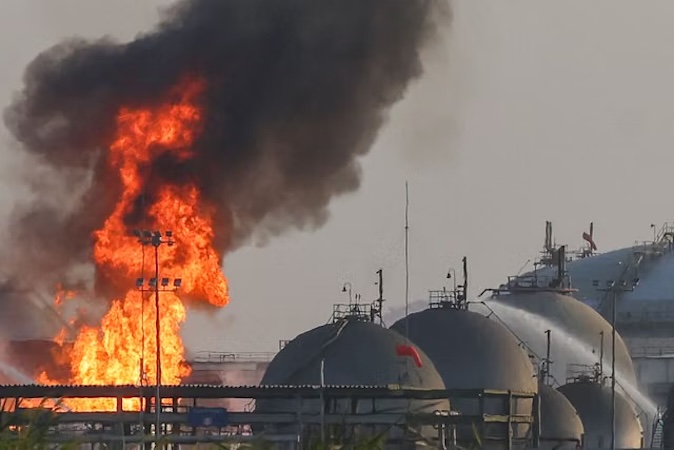
Riyadh's calls for international assistance, particularly from its American ally, have so far been unsuccessful.
The Iran-backed Houthis claimed to have targeted a site of the oil giant Aramco in Riyadh on Saturday, October 3. This is the second such attack in two weeks. Clashes between the Houthis and Saudi Arabia have not ceased since their resumption in July. This has opened a new front in the war in the Middle East. The kingdom, bordering Yemen, supports the internationally recognized government.
Things to discover
Saudi refineries have already been hit in July, August, and September. Saudi Arabia’s oil exports and energy infrastructure have been under pressure since the start of the war in Iran at the end of February. Hostilities between the Houthis, supported by Tehran.
In a lightning offensive, the Yemeni Houthi Islamists took control on Friday, September 11, of the Yemeni coast on the Red Sea and the islands of the Bab el-Mandeb Strait, a strategic passage connecting Europe to Asia.
They now have total control of the Bab El Mandeb Strait, which is a strategic passage point for global trade and a portion of Saudi oil. Moreover, they have established a foothold on Perim Island, located in the middle of the strait.
The capture of positions near Bab el-Mandeb, however, goes beyond the scope of the Yemeni war. The strait constitutes one of the main corridors of global maritime trade. Any increased capacity of the Houthis to exert military pressure there could therefore have consequences for commercial navigation, maritime insurance, supply chains, and, more broadly, on international economic security.
Saudi Arabia in a deadlock after Donald Trump’s refusal to strike the Houthis
In light of this situation, which further complicates the transport of hydrocarbons, Saudi Arabia has reportedly sought urgent intervention from the United States in response to the Houthis’ advances on the western coast of Yemen.
This spectacular advance has occurred without significant opposition from the Yemeni government forces supported by Saudi Arabia. So far, it has been in vain: the American president said no to the Saudi crown prince, seeking to avoid direct military action that could result in American casualties, and preferring to remain focused on the Strait of Hormuz.
Attacks have been carried out by the Houthis resulting in hundreds of deaths during their latest ground offensive, worsening the humanitarian crisis in the country. The hunger crisis in Yemen, the poorest country in the Arabian Peninsula, threatens to become “absolutely devastating,” warned the United Nations World Food Programme (WFP) on Friday.
Emmanuel Macron announced on Thursday, September 24, on the 8 PM news of TF1 and France 2 the deployment of “military means” to Saudi Arabia to “protect” the site of Yanbu. This port located on the Red Sea is among the most strategic energy infrastructures in the region.
In the face of the ongoing fuel crisis, France is accelerating internationally. While he assured that the authorities were doing “everything” to “avoid” shortages, and that the supply “of diesel, gas, fuel” was guaranteed “by the end of the year,” he did not completely rule out problems in early 2027 “if the crisis were to worsen.” The cause, he reaffirmed, is the war in the Middle East, and the extreme tensions in the strategic straits of Hormuz and Bab el-Mandeb, as well as, to a lesser extent, the war in Ukraine.
Moreover, diplomatic negotiations for a resolution of the regional conflict are at a standstill. The American news site Axios, citing three American officials, reported a meeting on Friday at Camp David of key members of Donald Trump’s cabinet to discuss the next steps regarding Iran and the situation in Yemen. Riyadh’s calls for international assistance, particularly from its American ally, have so far been unsuccessful.
The editorial team recommends
- Announced by Emmanuel Macron: LFI and the RN opposed to the deployment of French troops in Saudi Arabia threatened by Houthi Islamists.
- War in the Middle East: The capture of the Bab el-Mandeb Strait exacerbates the oil crisis and raises fears of a global economic shock.
- Advances of the Houthi Islamists: American-Saudi failure in the closure of the Bab-el-Mandeb Strait
Fancy reading all the articles?
Unlock all articles straight away. No obligation.