“The economy is at a standstill”: growth stalls again and France is on the brink of recession and will “hit the wall” without a budget, warns Roland Lescure.
The French economy is increasingly affected by bad news. The Minister of Economy lamented an "unprecedented conjunction" between the blockage of the Strait of Hormuz and heatwaves, which justifies this new decline. According to the latest forecasts from Insee, France's GDP recorded a decrease of 0.1% in the third quarter, following a stable second quarter and a first quarter also down by 0.1%.
By Karim Maloum
Published on 30 October 2026
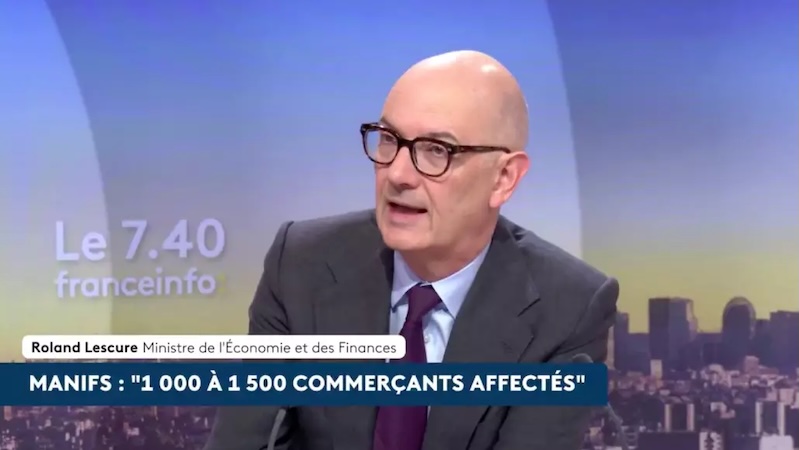
The Minister of Economy Roland Lescure, who does not rule out the use of 49-3 or ordinances to provide the country with a budget draft.
A cold shower. This is another piece of bad news for the government. Against the backdrop of war in the Middle East, after a summer marked by exceptional heatwaves and a volatile social return, the French economy is stalling again in the third quarter. The GDP of the hexagon slightly declined by 0.1% during the summer, according to the first estimates from Insee published on Friday morning.
Things to discover
The Minister of Economy Roland Lescure could only assess the damage this Friday on France Info. Invited to the morning show, the Minister of Economy was able to give his first impressions on the growth figures for the third quarter. Roland Lescure states, in a serious tone, that “in 2026, the French economy is at a standstill.” “It has been three quarters since growth has not been on the agenda […] if we do not have the budgetary recovery that we have included in the budget, we will hit the wall,” he adds.
🗣️🔴 "France will hit the wall" without a budget, assures the Minister of Economy, Roland Lescure. #canal16 https://t.co/qMDNh2j6O5
— franceinfo (@franceinfo) October 30, 2026
Moreover, in its latest data, Insee indicates that the country’s gross domestic product (GDP) fell by 0.1% in the third quarter of 2026, after stagnating in the second and declining by 0.2% in the first.
At the same time, inflation continues to accelerate and reaches 3.4% year-on-year – the highest since January 2024 – while household consumption decreases (-0.5% in October). “The conclusion of all this is that in 2026, the French economy is at a standstill,” warned the Minister of Economy and Finance on Franceinfo.
France is not heading for a crisis, but we need a budget
According to the head of Bercy, this situation results from an “unprecedented conjunction” of internal and external shocks, notably mentioning the summer heatwave and geopolitical tensions around the Strait of Hormuz that are fueling the surge in fuel prices. “It has been three quarters since growth has not been on the agenda,” he insisted, while national production had stagnated in the second quarter and declined by 0.2% in the first.
“France is not heading for a crisis,” but “today, if we do not have the budgetary recovery that we have included in the budget, we will hit the wall,” he warned. “I say it and I repeat it and I will repeat it until the end: we need a budget, we need a budget deficit of 5% or less. It is absolutely essential” to “find the path to growth,” the minister stated. He did, however, want to reassure all investors and businesses that “France is not heading for a crisis.”
As a reminder, the 2027 budget project is currently being discussed in the National Assembly. The executive hopes to pass a draft that will bring the public deficit below 5% of GDP, after a previous exercise pointed at 5.4%.
The minister, who does not rule out the use of 49-3 or ordinances
However, its formal adoption by a vote appears more than uncertain, due to the lack of a government majority in the Palais-Bourbon, and with the presidential election approaching. Failing to rely on a vote, the executive may, however, attempt to pass the text using 49.3, or even apply it by resorting to budgetary ordinances.
“We are divided on everything,” he lamented, yet “at the dawn of a presidential election, we should be able to come together on the essentials.”
Indeed, with six months to go before the country’s main electoral deadline, risks are accumulating for the Hexagon, both domestically, with social anger at its peak, a chronic deficit in public spending, and stagnant growth, as well as on the international stage, from the Strait of Hormuz to Ukraine.
“Either we get through this together, or we enter this real divided shock, and it will worsen things,” warned the minister, who does not rule out the use of 49-3 or ordinances to provide the country with a budget draft in case the parliamentary debate fails to achieve it.
The editorial team recommends
- 32% of the national education budget is used to pay for civil servants’ pensions, 30% for the Interior.
- France’s debt: the head of the IMF warns that it “will take time” to restore “confidence” in public finances
- 3,595.5 billion euros and 119% of GDP: French debt is once again nearing its historical record.
Fancy reading all the articles?
Unlock all articles straight away. No obligation.