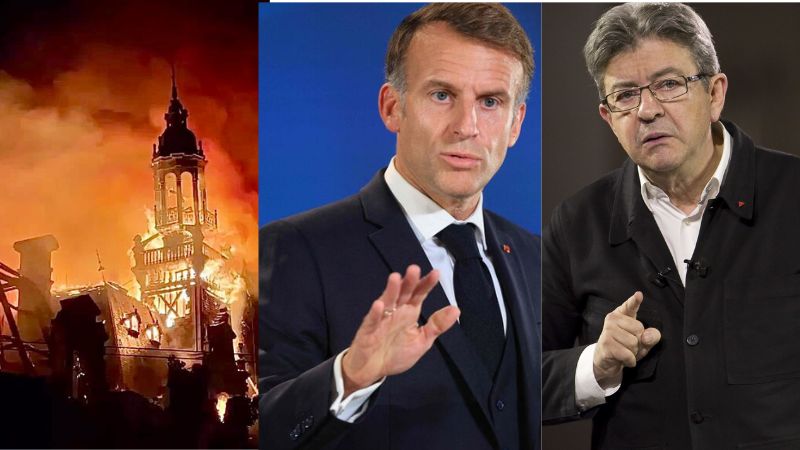
Macron and Mélenchon, the two faces of a Republic that is collapsing
There are mornings when you wake up with the feeling that something has broken in your country, and that it will not be repaired. This Sunday morning, what I feel is anger. An anger mixed with shame, sadness, and, I admit, a rather deep despair.
Published on 18 October 2026
Their responsibility is not the same, but their respective ambitions risk leading us to a dead end for which they will not personally pay the price.
The images from the day before are unbearable. Devastated shops, vandalized public buildings, fires, police officers targeted, streets surrendered to groups determined to impose their law. Behind these images, one question keeps coming back: how did France get to this point?
I refuse to see these scenes as a mere outbreak of violence, destined to subside with the smoke of the fires. What happened on October 17 reveals a more serious crisis. That of a state struggling to enforce its rules, of an authority publicly challenged, of a political class that seems to have lost even the sense of its responsibilities.
Two men bear, in my eyes, a major political responsibility in this decomposition: Emmanuel Macron and Jean-Luc Mélenchon.
Macron, the man who has exhausted the authority of the State
Emmanuel Macron wanted to embody control, modernity, efficiency. He may leave behind the memory of a president who primarily consumed the political credit of the presidential office, and at a dizzying speed.
Since he came to power, crises have followed one another, anger has accumulated, and fractures have widened. Institutions are weakened by political clashes, and the presidential voice has lost a considerable part of its strength.
It is not enough to condemn the violence after the fact, to promise sanctions and to proclaim that the state will not back down. This state must actually be able to protect citizens, defend property, guarantee freedom of movement, and prevent a handful of vandals from turning a city into a battleground.
Yesterday, the images of Paris and those of other affected cities showed a public power overwhelmed. Le Monde described a disoriented capital, confronted with mobile and determined groups, against which the law enforcement system showed its limits.
Who can seriously claim that this situation is normal?
I do not blame Macron for being responsible for every stone thrown, every broken window, every fire. The perpetrators of these acts must personally answer for what they have done. I blame him for presiding over a continuous degradation of the relationship between power, institutions, and part of the country, without managing to restore trust or to sustainably enforce republican authority.
A president is not responsible for everything. He is responsible for what he does with his power. And when, at the end of his term, the country seems more divided, the state more contested, and political speech more powerless, he cannot shift the blame onto circumstances, his opponents, or the difficulties of the times.
Mélenchon, the man who hopes to reap what disorder brings forth
Jean-Luc Mélenchon plays a different tune. He does not have presidential power, but he bears a political responsibility that his statements cannot erase.
He knows how to turn every crisis into a trial of the Republic, every clash into an accusation against the police, every difficulty into an opportunity to designate culprits. When violence erupts, he blames police command, speaks of organized disorder, accuses the authorities of having opened the door to chaos. He also calls on his supporters not to participate in looting. These two elements must be recalled together.
But what a strange relationship with responsibility it is to denounce the damage while systematically designating the authority responsible for containing it as the main culprit!
Since when does a police officer trying to restore order become guilty by principle? Since when must the institution that protects citizens apologize for existing before those who seek to challenge it?
Mélenchon knows the power of words. He also knows the effects of the permanent designation of enemies. He knows that anger mobilizes, that indignation gathers, that confrontation feeds political ambitions.
What I blame him for is playing with a fire that ordinary French people pay the price for. The shopkeeper whose store is destroyed does not live in television studios. The residents who find their neighborhood devastated do not have a permanent platform. The injured police officers are not accessories in an electoral strategy.
Mélenchon claims to be preparing for an alternation. But what Republic does he intend to lead tomorrow, if he contributes today to discrediting the institutions that precisely allow a democracy to function?
Two personal ambitions, one national bill
Macron and Mélenchon are politically different. They do not carry the same project or the same vision of society. Yet, they end up converging in the same deadlock: the higher interest of the country comes after their struggle to retain, conquer, or impose power.
One has governed without managing to reconcile the French with their institutions. The other wants to capitalize on their anger by pushing confrontation even further. One has exhausted the authority he had. The other exploits the gaps that this exhaustion leaves behind.
The former no longer controls events sufficiently to convince of his ability to govern. The latter would have us believe that the one who most loudly contests the existing order would necessarily be capable of restoring it.
I do not believe it.
Their responsibility is not the same, but their respective ambitions risk leading us to a dead end for which they will not personally pay the price. Because it is always the same ones who bear the brunt: employees, families, shopkeepers, taxpayers, residents of neighborhoods abandoned to violence, and public agents sent to the field to repair what politics has failed to prevent.
And do not come to explain to me that all this boils down to a question of money.
Yes, inequalities exist. Yes, poverty, educational difficulties, feelings of abandonment, and failures of public services fuel real anger. Denying them would be as absurd as it is dangerous.
But no injustice gives the right to loot a store. No humiliation justifies burning down a town hall. No social difficulty allows targeting a police officer.
National solidarity is essential. It cannot become a permanent excuse to renounce individual responsibility and respect for the law.
For decades, France has devoted considerable resources to social protection and reducing inequalities. It must continue to fight poverty and provide everyone with the means to succeed. But it must also regain the will to transmit common rules, to sanction violence, and to remind that living in a Republic implies rights, and as many duties.
A society that can no longer combine solidarity with demands ultimately weakens both.
What despairs me is what we are in the process of losing.
I am attached to France. To its history, its culture, its freedom of thought, to secularism, to this demanding idea that we can live together without submitting to fanaticism, intimidation, or power struggles.
I want a country where the teacher can teach, where the police officer can carry out their mission, where the mayor can administer their municipality, where the shopkeeper can open their store without fearing that a crowd will destroy it. I want a country where one can contest the government without wanting to overthrow the institutions, where one can demonstrate without turning the street into a battlefield.
Has this become an excessive ambition?
I look at Macron, trapped by his record and unable to restore confidence. I look at Mélenchon, convinced that the radicalization of anger serves his political purpose. And I wonder how much longer France can endure this war of ambitions without losing a part of itself.
A nation does not necessarily collapse in a day. It can also unravel slowly, through renunciations, calculations, incendiary speeches, and poorly exercised authority.
Yesterday, we may have glimpsed what happens to a country when those who should unite it contribute to its exhaustion.
I do not want to yield to fear nor resign myself. But I refuse to tell myself stories.
Macron will have had the power to govern. Mélenchon dreams of having the power to succeed him. Neither can claim to serve France if their personal ambition ultimately counts more than the political, moral, and republican survival of the country.
And perhaps this is, in the end, the most terrible: we are paying the price of their failures while they continue to fight for their future.
France deserves better than this alternative between powerlessness and escalation. It deserves leaders who love their country enough not to play with what still holds it up.
The editorial team recommends
Fancy reading all the articles?
Unlock all articles straight away. No obligation.