All Maastricht residents!
There is a common point among all the "important" candidates (all those who appear in the polls): they accept the framework of the EU as set by the Maastricht Treaty (1992) and "amended" by the Lisbon Treaty (2007), whose ratification constituted a real coup d'état against the French people who had voted against the "European constitutional treaty" in the 2005 referendum. From Mélenchon to Marine Le Pen, no one questions the clauses established in 1992, which involve the single currency and the budgetary discipline of the Commission.
By Denis Collin
Published on 5 September 2026
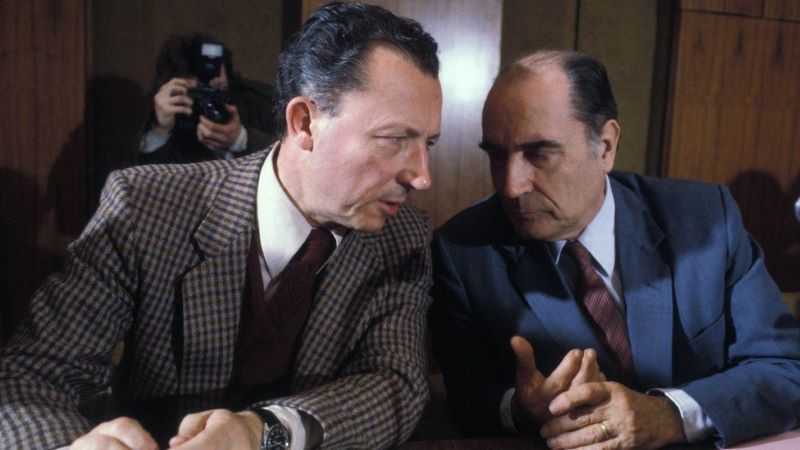
Mitterrand brought Jacques Delors into the PS, solely to help him overcome the resistance to the European project within the PS.
In his book The Opium of the Elites, Aquilino Morelle details how the French elites rallied to the “European project” of which Jean Monnet, a prominent agent of influence for the United States, was the great inspirer. Mitterrand, notably, among all his wanderings (from Pétainism to resistance, from French Algeria to the “break with capitalism”) always maintained this conviction of the necessary transcendence of the French nation within a European framework. This project had been defended by part of the French ruling class even before the war.
Mitterrand brought Jacques Delors into the PS, solely to help him overcome the resistance to the European project within the PS – Delors, who came from Chaban-Delmas’s cabinet, had nothing socialist about him. Let us also recall that as early as autumn 1981, Delors campaigned against socialist nonsense in the name of Europe and led the famous “turn towards austerity” whose sole objective was to keep France within the European monetary system (the famous “snake”).
Things to discover
In 1986, a first conclusion was reached in the “European Single Act.” Pierre Bérégovoy implemented banking deregulation, ahead of the scheduled deadlines. The Maastricht Treaty opened a new stage in European unification. The vast majority of the political class supported this treaty, with the exception of Jean-Marie Le Pen’s National Front (which garnered 12.4% of the votes and no deputies in the 1993 legislative elections). Only two dissenters from their respective parties, Jean-Pierre Chevènement, then a socialist, and Philippe Séguin, a member of the Chirac RPR, led a well-organized campaign for the “no” vote.
Today, the situation has changed significantly; the FN, now RN, has rallied to the EU; Jean-Pierre Chevènement’s movement exploded after his failed presidential attempt in 2002. Even as skepticism and outright hostility towards the EU have continued to grow among the people, the political representation of this opposition to the EU has withered, dividing into multiple competing factions that struggle, across all categories, to reach 5% of the votes.
Several polls indicate that there is a majority of French people who would like to be consulted on the EU
The question of the EU is, however, an essential question and should be at the center of the debates for the upcoming presidential election. The protection of French industry and agriculture against ruthless international competition is evident when one sees the terrifying disintegration of our industrial fabric and the crisis of an agriculture confronted with MERCOSUR, even as it is severely tested by the repeated heatwaves of this summer.
The “revolutionary” statements of Jean-Luc Mélenchon would often imply a break with European treaties, but he explicitly rejects this perspective. Finally, the highly concerning project to abolish the veto power of EU nations over foreign policy would mean the complete annihilation of the sovereignty of nations and thus, de facto, the disappearance of France reduced to the status of a Land of the Federal Republic of Germany.
Several polls indicate that there is a majority of French people who would like to be consulted on the EU, but Emmanuel Macron has opposed such a consultation, as he believes it would lead to France’s exit from the EU, following the British example. In short, sovereignty does not reside in the nation, according to the most prominent figures of the political class who claim to speak on behalf of the people.
By failing to raise these questions, the politicians vying for votes in the 2027 election themselves lend credence to the idea that this election is a parody of democracy. The most revolutionary are merely pale copies of Tancred, the nephew of Prince Salina in The Leopard, for whom “everything must change so that nothing changes.”
Fancy reading all the articles?
Unlock all articles straight away. No obligation.