The crisis of representation dominates the preparation for the presidential election.
The presidential election of 2027, which will conclude ten years of Macronism, has parties, movements, and leagues in a state of turmoil. While two candidates, Le Pen and Mélenchon, seem to dominate the election, figures from the right and left are multiplying. All believe they have a chance. But no one knows what could distinguish Messrs. Attal and Philippe or Retailleau, Bertrand, and Lisnard, not to mention the 'socialist' (?) contenders who are crowding at the gate. This free-for-all expresses the deep crisis of political representation affecting the French Republic today.
By Denis Collin
Published on 4 September 2026
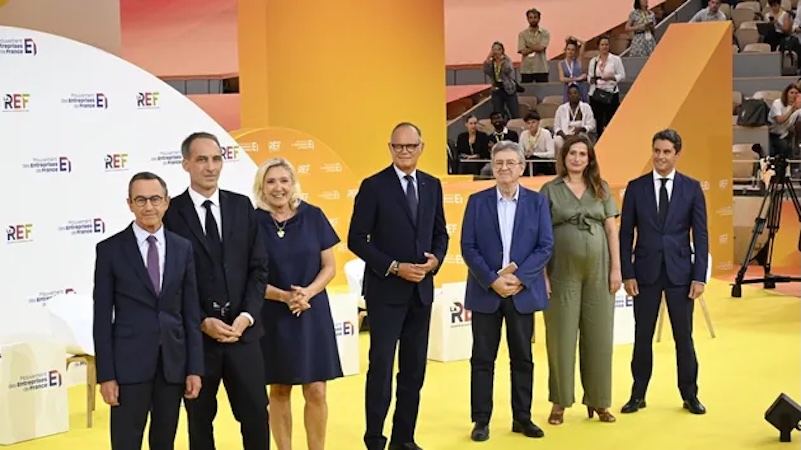
The French are not indifferent to the presidential election of 2027. It is a spectacle where the excesses of both sides add spice.
Democracy and Representation
If we go back to the sources, democracy is the power of the people, by the people, and for the people, to borrow Lincoln’s cherished phrase. “By the people”: if words have meaning, this means direct democracy, as it was practiced in Athens during the classical period or until recently in some Swiss cantons, through cantonal assemblies. One can also consider the referendum as a form of direct democracy.
Direct democracy – but we should simply say democracy – is where citizens deliberate together and express their will themselves. It is also this democracy that the Yellow Vests claimed under the slogan of Citizen Initiative Referendum (RIC). Rousseau, in the Social Contract, defends this democracy based on the activity of citizens. The general will cannot be represented, and it is easy to understand: I cannot let anyone want for me what I want!
Things to discover
Democracy requires rigorous conditions: the republic must be limited in number, citizens must be able to know each other, and citizens must be able to deliberate in the silence of passions, which implies that factions (parties, interest groups, etc.) have no place there. An idea that Simone Weil echoed in her Note on the General Abolition of Political Parties.
Rousseau was realistic enough to know that democracy understood in the strictest sense was probably not a regime made for men… The republic differs from democracy in that it is a mixed regime that contains monarchical and aristocratic elements combined with a democratic foundation. Republican theorists start from well-known deviations of democracy to propose a type of regime that guarantees both the freedom of citizens and the stability of the political community. Democracy can transform into the power of the mob (ochlocracy) or into the tyranny of the majority. But above all, since man does not live by politics alone, the functions of leadership and organization must be entrusted to certain citizens who will be freed from other tasks to fully dedicate themselves to their office. Representation imposes itself as the necessary mediation.
The people formally hold the ultimate power, sovereignty, but they exercise it either directly or through their representatives. These representatives are selected and thus form an elite that almost naturally tends to separate itself from the people and to pass its own interests off as the interests of the people. There is no “organic unity” between the people of citizens and the political elite supposed to represent them. There is always a conflicting dialectic between this elite and the people. It is precisely this conflicting relationship between the “greats” and the people that republican theorists acknowledge by following Machiavelli’s teaching[1]. This conflict is necessary and is the only means to guarantee freedom. Moreover, fascism is precisely this attempt to constitute an organic unity of the people and the leaders, an attempt to abolish conflict.
The Fifth Republic and Its Crisis
The Fifth Republic was born, as we know, from the inability of the parliamentary Republic (the Fourth Republic) to emerge from the Algerian War. De Gaulle returns to power and hopes to implement his concepts, developed in the “Bayeux speech” (June 16, 1946):
“It is therefore from the head of state, placed above the parties, elected by a college that encompasses Parliament, but much broader and composed in such a way as to make him the president of the French Union as well as that of the Republic, that the executive power must proceed. It is the head of state’s responsibility to reconcile the general interest regarding the choice of men with the direction that emerges from Parliament. It is his mission to appoint ministers and, first and foremost, of course, the Prime Minister, who must direct the policy and work of the government. It is the head of state’s function to promulgate laws and issue decrees, for it is towards the entire state that these engage the citizens. It is his task to preside over the Councils of government and to exercise that influence of continuity that a nation cannot do without. It is his prerogative to serve as an arbiter above political contingencies, either normally through counsel or, in times of grave confusion, by inviting the country to express its sovereign decision through elections. It is his duty, should it happen that the homeland is in peril, to be the guarantor of national independence and of the treaties concluded by France.”
This conception is radically opposed to the French tradition of parliamentary Republic and has often been labeled “Bonapartism”[2]. Mitterrand denounced “the permanent coup d’état.” However, within this conception remains a strong democratic element: in de Gaulle’s mind, the head of state had to ensure that the people retained their trust in him, which was the role of referendums or legislative elections. The president lost the referendum or, if his supporters lost the legislative elections, the president had to resign. Let us give credit to the general: he did not want to start a career as a dictator!
However, the position occupied by the president, reinforced by election by universal suffrage (1962), led to a damaging polarization of political life and tended to freeze representation according to patterns distancing it from “real life.” Bipolarization prevents the emergence of new political forces that can truly act within institutional frameworks. It tends to do the opposite of what de Gaulle claimed to do; it organizes the government of one party against the entire nation. We had the UDR state, then the infiltration of the state by the PS, with all the associated corruption issues. We can credit de Gaulle with his personal honesty and his disdain for people of money, but they nevertheless thrived under the Fifth Republic, long before 1969. Pompidou, a Prime Minister from the Rothschild bank (funny, isn’t it?), is the embodiment of the social reality of power acting behind the general.
De Gaulle’s resignation following the failure of the 1969 referendum ended the illusions of Gaullism. Pompidou would accelerate integration into the EEC, inviting the British to join. Then the “sweater-clad right” took power with Giscard, promising to end the reign of “the friends and the crooks” (Poniatowski). Mitterrand delightfully sat in the general’s chair and used and abused all the tricks given to him by the Constitution and the practices of his predecessors. Nepotism, favoritism, the use of state powers for personal ends, he would take all this to previously unknown levels.
When the left was defeated in the legislative elections of 1986, Mitterrand inaugurated “cohabitation” and the Fifth Republic took on a parliamentary turn. The institutions are not frankly Bonapartist: it is a semi-Bonapartist, semi-parliamentary system, since Michel Debré, the main author of the Constitution, wanted the government to be responsible, under certain conditions, to Parliament (Article 49). Michel Debré was, moreover, opposed to the election of the president by universal suffrage. Supporters of the 1958 Constitution saw in cohabitation proof of the malleability of this constitution.
From this situation will arise two consequences: the first is that the president becomes accustomed to being disavowed by the people without being overly bothered, the second is that a sort of consensus will form to put an end to this damned cohabitation. They disregard the results of the referendums (2005) and, to avoid the inconveniences of popular censorship, the referendum itself disappears from the practice of the regime. On the other hand, Jospin and Chirac agree to reduce the president’s term to five years and to reverse the electoral calendar so that the legislative elections occur after the presidential election, which almost always guarantees that the Assembly will be favorable to the president. Thus, the weight of the executive is reinforced, and thus the worst of institutions continues to assert itself until we arrive at this president who thinks he is Jupiter.
Decomposition of the French Political System
This produces an increasing disconnection between citizens and political assemblies. Parties become mere electoral machines and no longer organs contributing to the expression of the vote, as the Constitution intended. The consequence: people no longer vote for a man, ideas, or a policy, since, in any case, this man or party no longer represents the citizens. They vote against, to “block”. The farce of Chirac’s election in 2002, to “block Le Pen”, inaugurates what becomes the rule. In a small book titled Elections Against Democracy, Florent Bussy conducted a thorough critique of the famous “useful vote”, which reduces the choice of voting to two versions of the same policy. When all choice is reduced to deciding between the lesser and the greater evil, one ends up forgetting that the lesser evil is still an evil. Twice, Macron, who receives less than one voter registered out of five, is elected not because the French overwhelmingly agree with him, but because he would be a “lesser evil” compared to that worn-out scarecrow that is the FN/RN. Thus, we have seen LFI members campaigning for the election of Ms. Borne or Laurent Wauquiez…
Parties are no longer organizations gathering militants who decide together on the party’s line and leaders, but rather “gaseous movements” that are in reality “parties of the leader”[3]. LFI is the caricatured version of this, but other parties are all affected by this “verticalism”. The less citizen engagement there is, the fewer coherent political lines there are, and the more the personality or ego of the leader prevails. LFI, again, is the most affected party, and we see a personality cult developing there, directly copied from the personality cults of Stalinist movements. In 2017, militants even launched a movement to offer a gift to Mélenchon for his birthday. It stopped very quickly, but it was revealing. Under pressure from the appetites of aspiring leaders, traditional right has exploded into a multitude of factions, making it quite difficult to say what separates them. Bertrand, Retailleau, Le Maire, Lisnard, and tutti quanti selling the same mush based on the elimination of social gains and support for large capitalist groups, within an unchanged Europe.
At the PS, to show the rejuvenation of the party, we see among the candidates for the nomination François Hollande and Ségolène Royal : the return to childhood is a kind of senility. Glucksmann represents only himself, but he has part of the media with him. It is true that he resembles Macron enough to attract those who still believe they can shape public opinion. There remain multiple small groups with their candidates, many of whom will not even obtain the five hundred sponsorship signatures. The RN itself, which seems to dominate this chaotic political landscape, is a very divided party between liberals (like Reagan or Thatcher) and the “Bonapartists” more concerned with their popular base. The Zemmour-Knafo tandem may appeal to some radical (right-wing) intellectuals, but has no chance of breaking through in this election that will place Marine Le Pen at the center of the game, since her main opponent presents himself as the one who can defeat Marine Le Pen.
Let the party begin!
The French are not indifferent to the presidential election of 2027. It is a spectacle where the excesses of some and others add spice. The spectacle is all the more interesting as it is practically unprecedented : on the left, there is a defense of Islamist groups that vomit on homosexuals and feminism, and are fundamentally perfectly reactionary groups, while Marine Le Pen’s party welcomes Jews, homosexuals, and Muslims who want to live in peace in what is their country. To animate the spectacle, we can count on the chief showman Mélenchon who, to show his moderation, has threatened journalists with things “they can’t even imagine” while MP Clémence Guetté denounces couples with children as “Pétainist” and another LFI executive wants to “de-Westernize France”. Things have reached the point where some voters of Mélenchon 2017 imagine (in private and far from all prying ears) that they could now “block Mélenchon”…
All that remains is to dive or dive back into The Society of the Spectacle by Guy Debord :
“The false choice in the spectacular abundance, a choice that resides in the juxtaposition of competitive and supportive spectacles as in the juxtaposition of roles (mainly signified and carried by objects) that are both exclusive and intertwined, develops into struggles of phantom qualities intended to excite adherence to quantitative triviality.”
Denis Collin
[1]I have had the opportunity to develop several times the interest of modern republicanism, notably in Revive la République (Armand Colin, 2005), Comprendre Machiavel (Armand Colin, 2008), The Length of the Chain (Max Milo, 2011) and in numerous articles.
[2]I mean Bonapartism in the sense that Marx gives it in The 18th Brumaire of Louis Bonaparte : a power that rises above all classes… to better save the bourgeois order.
[3]A relevant analysis of this transformation of parties can be found in Mauro Calise’s small book, The Personal Party. The Two Bodies of the Leader, Editori Laterza, 2000, 2010.
Fancy reading all the articles?
Unlock all articles straight away. No obligation.