Increase of the minimum wage by 1.6%, decrease in the price of diesel… What to remember from the government’s announcements following the social conference
Prime Minister Sébastien Lecornu, accompanied by his ministers Jean-Pierre Farandou, Serge Papin, and Roland Lescure, held a press conference following the social conference with trade union and employer organizations organized this Monday morning at Matignon. The government announces a 1.6% increase in the minimum wage (Smic) effective December 1, a wage monitoring committee, and a decrease in diesel prices by 21 cents…
By Rupture Editorial Team
Published on 9 November 2026
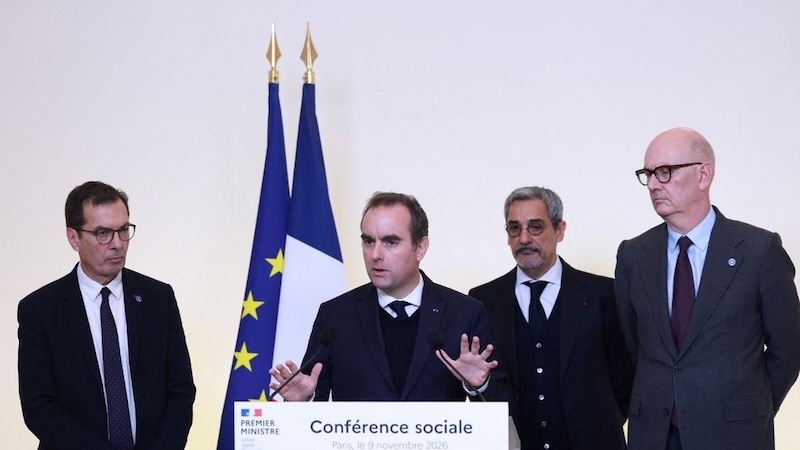
During his speech, the Prime Minister acknowledged that "social tensions are high" and that there are "political concerns about the future."
“The government’s duty is to commit to realistic and achievable promises.” The government announces a 1.6% increase in the minimum wage (Smic) effective December 1, a wage monitoring committee, and a decrease in diesel prices by 21 cents…
This Monday morning, Sébastien Lecornu brought together unions and employers at Matignon for a social conference. It was intended to “provide answers to questions of purchasing power and wages,” according to the Prime Minister’s office, addressing the issues at the heart of the demands from recent mobilizations.
Things to discover
During his speech, the Prime Minister acknowledged that “social tensions are high” and that there are “political concerns about the future.” According to him, the social conference held this Monday allowed for “working on proposals.”
Five representative trade union organizations (CFDT, CGT, FO, CFE-CGC, and CFTC) and three employer organizations (Medef, Les Entrepreneurs, and U2P) were present at the table. “Social tensions are high, there are political concerns about the future,” acknowledged Sébastien Lecornu during a press conference following this social conference, alongside his ministers Jean-Pierre Farandou (Labor), Serge Papin (SMEs, Commerce, and Purchasing Power), and Roland Lescure (Economy and Finance).
The minimum wage at 1,502 euros net
The Minister of Labor and Solidarity, Jean-Pierre Farandou, began by announcing an increase in the minimum wage to “1,502 euros” starting next month, which represents an increase of about 24 euros, far from the demands of the unions. The CFDT was calling for a 100 euro increase and the CGT for about 150 euros.
“We will anticipate the increase in the minimum wage on December 1 with a 1.6% increase. We thus surpass the threshold of 1,500 euros,” he explained. While specifying that this brings the total increase in the minimum wage to “5.3% by 2026,” which is an increase of “75 euros net.”
It is “the second largest increase in 20 years,” asserted Prime Minister Sébastien Lecornu, defending a “boost” that “is not just symbolic.” “I think we should not underestimate” this increase decided by the government, the first since 2012, he added. The head of government also believes that it will “not lead to job losses,” as feared by employers.
🔴 🗣"[Nous allons] anticipate the increase in the minimum wage on December 1 and raise this increase to 1.6% (…) We surpass the threshold of 1,500 euros, we are at 1,502 euros. By the year 2026, the minimum wage will have increased by 5.3%,” claims Jean-Pierre Farandou, Minister of Labor. #canal16
— franceinfo (@franceinfo) November 9, 2026
The Secretary General of the CFDT, France’s largest union, Marylise Léon, deemed it “insufficient” while welcoming that, “for the first time,” a number of aids to companies are conditioned on wage negotiations at the branch level. “These are the last 15 days of chance,” she warned as the Prime Minister has requested results by early December.
The fuel allowance extended to 1,000 euros
The fuel allowance, a tax-exempt aid that can reach 1,000 euros and that employers can grant to their employees, will be extended in 2027, also announced the Minister of Economy Roland Lescure.
Its extension will be included in the framework of the bill on the financing of Social Security, he specified. In response to the surge in fuel prices, the government announced at the end of September that it would raise the ceiling for this aid provided by employers from 600 to 1,000 euros.
Reduced contributions for businesses
The government will propose raising the existing ceiling from 7,500 euros to 10,000 euros, beyond which overtime is taxed, announced the Minister for SMEs, Commerce, and Purchasing Power, Serge Papin.
The government will also propose to “exempt (…) the coverage of public transport subscriptions at 75%” as part of the 2027 finance bill, he added during a press conference at Matignon following the social conference with trade union and employer organizations.
It will also propose to “open to companies with more than 50 employees” the exemption from CSG for the value-sharing bonus of a company, a profit-sharing scheme for employees, he said.
The editorial team recommends
- “The economy is at a standstill”: growth stalls again and France is on the brink of recession and will “hit the wall” without a budget, warns Roland Lescure.
- Mobilization on November 5: 500,000 to 700,000 protesters expected this Thursday outside Paris, Nuñez wants a “robust” system.
- The economy is fundamentally political: Elon Musk’s empire hit by the victory of the Democrats, chaos in France would weaken businesses.
Fancy reading all the articles?
Unlock all articles straight away. No obligation.