Immigration in Europe: Nearly 46,000 Algerians targeted by the obligation to leave the territory in 2025
Hundreds of thousands of orders to leave the territory have been issued to foreign nationals in an irregular situation by the member countries of the European Union in 2025. Algerians are among the main nationalities affected. This situation is mainly explained by the fact that France is the country that has issued the largest number of expulsion orders, hosting the largest Algerian community in Europe.
By the correspondent of Rupture in Algiers Yacine Aït Ouffella
Published on 4 November 2026
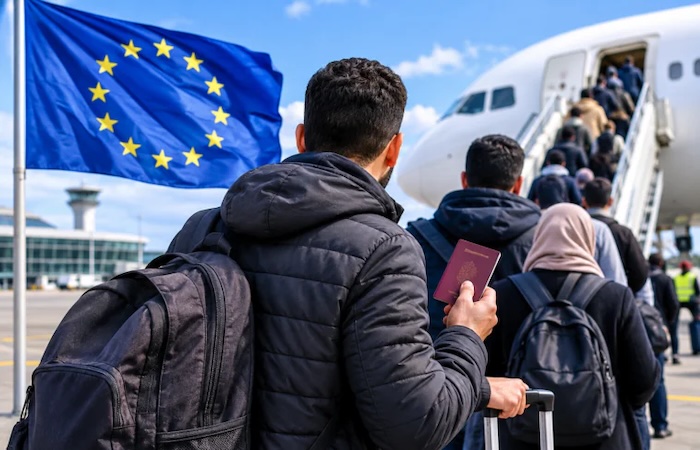
With 491,950 obligations to leave the territory issued and 135,460 people actually returned to a third country (outside the EU), the execution rate of these orders was thus 27.5% in the European Union in 2025.
In 2025, Algerian nationals were the first nationality affected by removal decisions in the European Union, with 45,890 orders to leave the territory issued, significantly ahead of other nationalities, notably Moroccans (29,220 orders), Turks (24,780 orders), and Syrians (20,030 orders), according to Eurostat data.
Things to discover
This situation is mainly explained by the fact that France is the country that has issued the largest number of expulsion orders, hosting the largest Algerian community in Europe.
In France, the obligation to leave French territory (OQTF) can be pronounced when a foreigner is in an irregular situation or after a residence permit refusal.
The measure may provide for a voluntary departure period, usually set at 30 days, or impose an immediate departure. The person concerned also has the option to contest the decision before the administrative court.
However, despite this high number of administrative decisions, Algerians are not among the top five nationalities that have made an effective return to their country of origin, due to administrative obstacles such as the issuance of consular passes, Eurostat further explains.
There are several reasons why there is a low execution of obligations to leave the territory in France (10.9% in 2025). There are many legal remedies that, although often successful, delay or prevent them. The complexity of the procedures is also exacerbated by administrative issues, lack of cooperation from countries of origin, and the rejection of the individuals concerned.
An execution rate of 27.5% in the EU
With 491,950 obligations to leave the territory issued and 135,460 people actually returned to a third country (outside the EU), the execution rate of these orders was thus 27.5% in the European Union in 2025.
According to Eurostat figures, Germany recorded the highest number of returns, with 29,295 people, ahead of France (14,940) and Sweden (11,250).
The ratio of returns to departure orders reaches 53% in Germany, compared to 10.9% in France.
In 2025, 135,460 nationals from third countries effectively left a member state of the EU following a removal decision, compared to 112,040 in 2024, an increase of 20.9%.
This figure corresponds to 27.5% of the number of departure orders issued during the same year. However, this is not an execution rate of only the decisions made in 2025, as some returns concern measures pronounced in previous years.
According to Eurostat statistics reported across Europe, Turkish nationals rank first with 12,785 returns, followed by Georgians (10,330), Syrians (8,265), Albanians (7,970), and Russians (5,670).
These statistics include voluntary departures and forced returns. The differences observed between member states may be related to administrative procedures, judicial remedies, and the conditions for organizing removals.
Fancy reading all the articles?
Unlock all articles straight away. No obligation.