Legislative elections in Israel: Benjamin Netanyahu’s camp leads after 50% of the ballots counted, according to the Electoral Commission.
Israel enters a zone of political disturbances. After counting 51.8% of the ballots, Mr. Netanyahu's Likud (right) and its allies are credited with 56 seats out of the 120 in the Knesset, compared to 49 for the opposition bloc and 15 for the Arab parties. No bloc has a majority in the Knesset.
Published on 28 October 2026
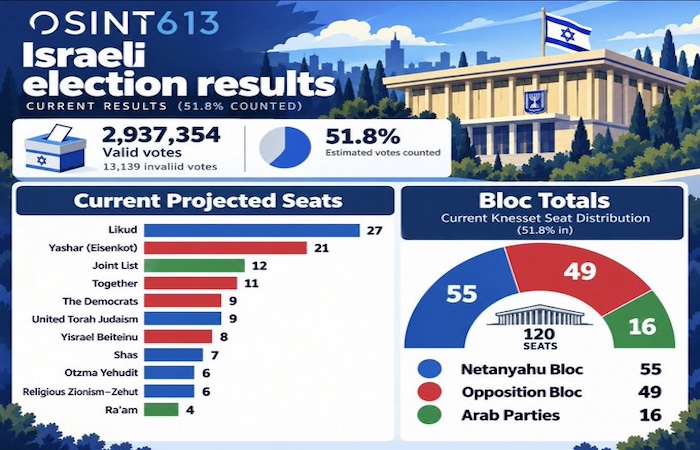
Benjamin Netanyahu's camp leads after 51.8% of the ballots counted.
The outcome of the election remains uncertain in Israel. The day after the legislative elections on October 27, Israel wakes up without a clear perspective. Benjamin Netanyahu’s coalition is ahead of the opposition bloc after half of the votes cast have been counted, according to data published Wednesday by the Israeli Central Elections Commission.
Things to discover
At 8 a.m. this Wednesday morning, with just over half of the ballots counted (about 52%), Benjamin Netanyahu’s coalition is credited with 55 seats. The opposition, led by its main rival Gadi Eisenkot, has 49, while the Arab parties total 16 seats. The Knesset, the unicameral parliament of Israel, has 120 seats. Neither of the two “blocks” was therefore in a position to claim power.
These partial results are likely to vary greatly, as several exit polls showed the camps neck and neck and without a parliamentary majority. Voter turnout reached 77.7%, its highest level since 1999. This is the first national election since October 7, 2023.
The evening had delivered a more ambiguous message. The main exit polls (Kan 11, Channel 12, Channel 13) placed Likud between 24 and 25 seats and the Netanyahu bloc around 50, often slightly behind or tied with Eisenkot’s camp.
Globes summarizes it simply: most exit polls gave an advantage to the opposition, but the count actually places the coalition in the lead. Netanyahu claimed the position of the leading party and called for the formation of a right-wing government.
An open arithmetic
The Netanyahu bloc has a relative advantage: it is closer to a majority than the opposition and can seek support from the right. The Arab parties, showing a significant increase from the 10 seats in 2022, could theoretically play kingmakers, but strong reluctance remains on both sides.
The “double envelope” ballots (soldiers, diplomats, etc.) have not yet been integrated and could still shift one or two seats. Ra’am remains just above the 3.25% threshold.
Compared to 2022, the Netanyahu camp has declined (it then had about 64-68 seats) and Likud has dropped from 32 to 27. However, the resilience of the ruling party is clearer than the projections suggested on the evening.
If these estimates are not final, the absence of a majority means that the parties will now embark on weeks of intense negotiations to try to reach the 61 seats necessary to form a governing coalition. The Electoral Commission will gradually publish the results, during the night from Tuesday to Wednesday, a process that could take several days.
The editorial team recommends
- Legislative elections in Israel: Gadi Eisenkot, who has taken the lead of the anti-Netanyahu movement, is neck and neck in the polls with the current coalition, including Likud.
- October 7: a tragedy for Israel, a shame for Islam, and a revealer of the excesses of Islamism
Fancy reading all the articles?
Unlock all articles straight away. No obligation.