The “troublemakers” against the social movement
The demonstrations on October 17 gathered a huge crowd against the government's economic and social policies, and that is where we must start. The figures between 550,000 and 800,000 demonstrators across the country are well beyond all similar days in recent years, but they only imperfectly reflect the exasperation of the people of this country.
By Denis Collin
Published on 19 October 2026
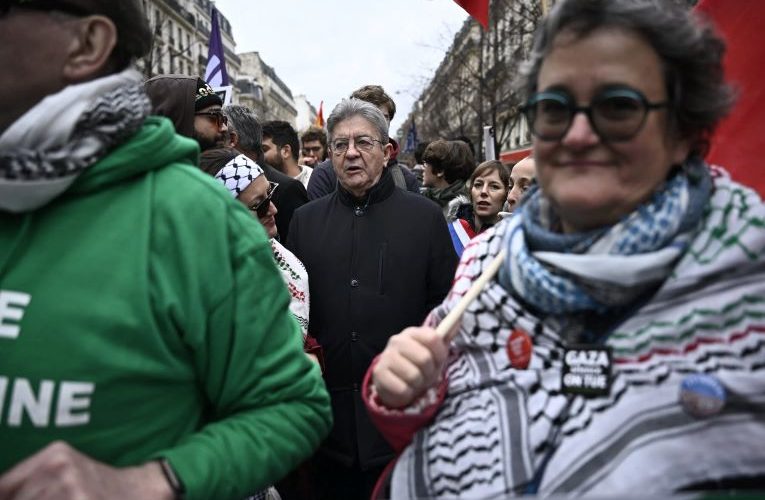
Radical Islamists manipulate LFI.
The day before, the radios had hammered on the risks of violence, on the rioters, on the damage, and on police repression: it was enough to listen to France Info for an hour to be dissuaded from going to demonstrate. But the price of diesel or domestic fuel is choking workers, employees, or self-employed. The announcements of the “heist of the century” that is the budget proposed by the government do not fail to worry (see Jacques Cotta’s analysis on his Youtube channel). The student movements add to this general climate, on the brink of political crisis.
Things to discover
But these demonstrations have also been seriously distorted by outbreaks of violence, fires, looting, and various assaults. The major cities, Paris, Lyon, Marseille, Bordeaux, Limoges, etc., have been the scene of real riot scenes. The fire and near-destruction of the town hall of Limoges is just the most spectacular event of this day, which sometimes appears as a day of chaos and desolation – one thinks of the shopkeepers (and their employees) who saw their entire street devastated by bands of looters.
Obviously, as one might expect, the media hardly talk about these looting scenes, and the purpose of the demonstrations on Saturday, October 17, takes a back seat. If the rioters are almost as old as the demonstrations, if the use of provocateurs manipulated to facilitate the crushing of popular uprisings is well documented, one cannot limit oneself to these explanations, especially since they require no serious proof.
The rioters could easily be classified in the category of “ultra-leftists” who do not believe in peaceful methods of political action and seek confrontation with the state apparatus, a prelude to any revolutionary movement. This is the famous cycle of “provocation-repression-mobilization”: after all, the paving of rue Soufflot in 1968 was indeed the prelude to the gigantic general strike movement of May-June 1968! This vision of “exemplary” direct action no longer finds many organized adherents with any influence.
The time of the “Proletarian Left” and the “Maoists” is well over! However, there are small groups, without ideological cohesion or constructed political projects, that could be attracted to violent action, primarily targeting institutional buildings. The famous text The Insurrection That Comes, written by the “Invisible Committee” in 2007, could be an expression of this desire to blow up the system of (true or alleged) representative democracy. This violent revolutionaryism could be compared to the Russian nihilists or anarchists advocating exemplary action.
But it is quite clear that the “rioters” of October 17 are, for the most part, of another kind. Islamist groups have an interest in the development of chaos, to fracture French society as much as possible and to cut short any movement that could unify ordinary people of all backgrounds. This is a low-cost version of classic terrorist strategies.
Mélenchon is not the great puppet master; since he has gone to the “dark side of the force,” he is as manipulated as he is manipulative
The Hamas flag and “Free Palestine,” the wearing of the keffiyeh as a rallying sign indicate that the “Palestinian” ideology is beginning to structure groups ready to engage in violent action, between “enraged” individuals and militants from Salafist and Frériste movements.
They have long since joined forces with certain sectors of LFI, even if it seems quite bold to claim that all these violent groups are manipulated by LFI – it would be more accurate to reverse the order: radical Islamists manipulate LFI all the more easily as the prospect of elections dominates the thoughts of political leaders and the heads of LFI do not shy away from any demagogic assertion. The de facto fusion between LFI and the “decolonial” groups like the PIR makes all political boundaries very porous.
Mélenchon is not the great puppet master; since he has gone to the “dark side of the force,” he is as manipulated as he is manipulative, and I have difficulty understanding the astonishment of many journalists at the apparent talents and culture of this man.
The last “current” of the rioters is simply composed of delinquents who take advantage of the opportunity to restock their shoe cabinets, their wardrobes, or the collection of jewelry intended for their girlfriends! “My parents can’t pay for my Crocs,” replies a 13-year-old kid to a demonstrator who questions him (France Info). Raised in the cult of brands and consumer society, devoid of any “superego” and any shame (the only shame they feel concerns precisely the “brands” they want to wear like tribal tattoos), these young people form a continuum from petty to serious delinquency.
Among all these very different types of rioters, there are many bridges, and in the excitement of the moment, one becomes less discerning. But what makes this explosive mixture possible, with the consequences we observed on October 17, is that all safeguards have been removed. The loss of authority in families has produced generations of crazies: a child who does not learn his own limits literally becomes crazy.
The disintegration of the school institution has perhaps definitively ruined the notion of authority and respect for the law. Finally, the organizations that structured public life, parties and unions, have all, to varying degrees, become “gaseous” organizations, to use Mélenchon’s term regarding his own organization.
There was a time when political and union order services genuinely contributed to limiting excesses. One did not joke with the order service of the CGT or with that of the Lambertist OCI. But all that has fallen apart, and it is an anomic crowd that attempts to demonstrate against the government’s policies, over which no one seems to have any control.
We feel that we are on the brink of an abyss and that our country could slip into civil war. Since Plato, we know that anarchy leads to tyranny. Chaos can only please those who love tyranny or want to become tyrants themselves. But who can prevent the worst? None of those who have produced it voluntarily or blindly. A strong reaction from the depths of our country is needed. Is it still possible?
The editorial team recommends
Fancy reading all the articles?
Unlock all articles straight away. No obligation.