War in Ukraine: the European Commission proposes a loan of 45 billion euros to Kiev for 2027 and tightens the noose on Russian revenues
The European Commission proposes that EU member states grant a new loan of 45 billion euros to finance Ukraine's military and budgetary needs in 2027. "We believe this is the best way to give Ukraine a strong position at the negotiating table," emphasized the president of the European executive. Brussels also intends to strengthen Ukraine's position in discussions with Moscow.
Published on 18 November 2026
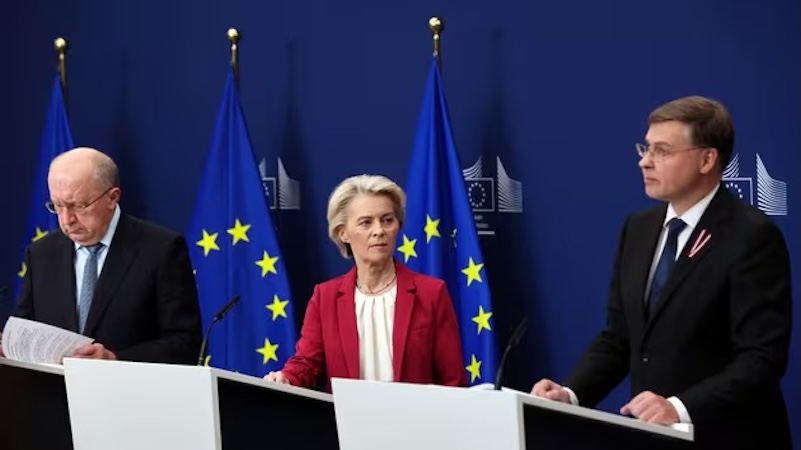
The European Union proposes a new loan of 45 billion euros to Ukraine for 2027.
The European Commission will propose to the 27 to grant a new loan of 45 billion euros to Ukraine to cover its budget deficit in 2027, announced its president, Ursula von der Leyen, on Wednesday, November 18.
“We believe this is the best way to give Ukraine a strong position at the negotiating table,” she stated before the press. And Kiev will only have to repay “once Russia has paid for the destruction it has caused in Ukraine,” she added.
Things to discover
This new loan is intended to cover a deficit estimated by Ukraine at around 70 billion euros. Other allied countries of Kiev are expected to provide the remaining 25 billion that is still needed. This loan will be in addition to the 45 billion euros already planned for 2027, as part of a 90 billion loan already granted by EU countries by the end of 2025. About 20 billion euros will be allocated to the budgetary needs of the Ukrainian state and 25 billion to finance its war effort, nearly five years after the Russian invasion in February 2022.
The additional budgetary need of Ukraine is estimated for 2027 at 70 billion euros, with three disbursements until 2028. The EU is expected to cover two-thirds of this, with other allies (United Kingdom, Norway, Canada, and Japan) sharing the rest.
A joint loan
The president of the European Commission, Ursula von der Leyen, announced the new mechanism, called the “Instrument for Coordinated Support to Ukraine,” during a press conference in Brussels, flanked by her Commissioner for Economy, Valdis Dombrovskis, and her Commissioner for Defense, Andrius Kubilius.
“We believe this is the best way to give Ukraine a strong position at the negotiating table,” the Commission president stated before the press. “It is important to continue to support Ukraine while maintaining pressure on the aggressor, Russia,” Valdis Dombrovskis had stated the day before on Euronews. “Russia only understands the position of strength.”
The loan guarantee would be secured by the available margins of the EU’s multiannual budget. Leaders are set to discuss this at an extraordinary European summit on November 26. The use of these margins requires their unanimous agreement: behind the financial mechanism lies a new political test.
Towards an agreement with 27 and not 24?
Cautiously, the European Commission has chosen this time not to propose using the frozen assets of the Russian central bank, immobilized in the EU, in the face of opposition from several countries, including Belgium. The bulk of these assets, around 210 billion euros, is located in Brussels, in the vaults of Euroclear.
However, it hopes that this loan will be made this time with 27 and not 24, as was the case during the previous loan of 90 billion euros. The Czech Republic, Slovakia, and Hungary had obtained from this country to participate in this financial effort.
“I am very confident that we will reach an agreement with 27”, assured Ursula von der Leyen. The 27 EU countries “clearly say they want to support Ukraine”. The difference is that some only want to do so for civilian aid, which is “possible” since this loan is divided into two parts, one civilian and the other military, the Commission president assured.
The editorial team recommends
- War in Ukraine: Volodymyr Zelensky confirms targeting the Crimean bridge, for the second day, Russia promises to “restore” it.
- War in Ukraine: Emmanuel Macron criticizes “those who want to ration” aid to Kiev and “force it into an unjust peace.”
- War in Ukraine: the Abu Dhabi negotiations failed due to Russian intransigence, no diplomatic breakthrough has been announced
Fancy reading all the articles?
Unlock all articles straight away. No obligation.