September 11: The Day Darkness Tried to Bring Down Freedom
Some dates become scars. Just think of September 11, 2001. That morning, Manhattan did not yet know it would enter History through fire.
Published on 11 September 2026
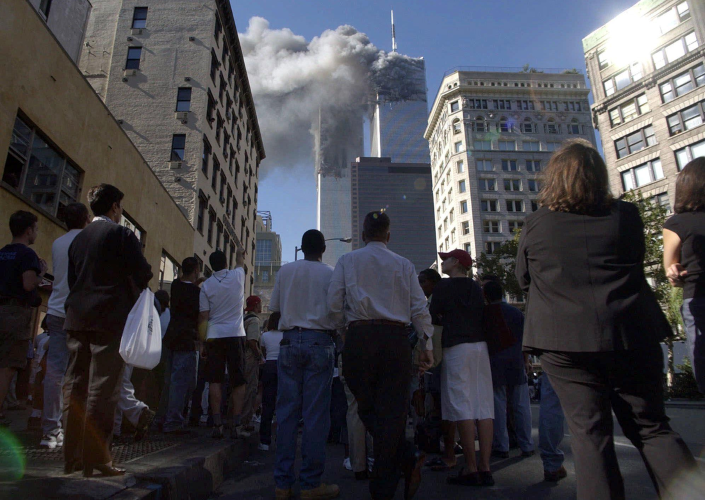
In a few seconds, New York understands that what is happening is not an accident, but a declaration of war.
The planes had taken off like so many other planes, filled with ordinary travelers, with lives both tiny and immense. Then the sky turned into a weapon. At 8:46, the first plane strikes the North Tower. Seventeen minutes later, a second one guts the South Tower. In a few seconds, New York understands that what is happening is not an accident, but a declaration of war. Nearly three thousand human beings will die. They had different nationalities. They spoke different languages. They may have prayed, or not prayed. They were Jews, Christians, Muslims, atheists, agnostics, believers of all kinds. They were simply human beings.
Perhaps this is what the assassins understood the least. They believed they were striking America. They were striking humanity. For September 11 was not just an attack on a power, a city called New York, or two towers that became symbols. It was an attack against an idea: that of a world where the individual can live, work, love, believe or not believe without asking permission from a god interpreted by men.
Al-Qaeda did not just want to kill. It wanted to impose a worldview. A worldview where freedom becomes a fault, where doubt becomes a weakness, where women must be submissive, where religion ceases to be a matter of conscience and becomes a law intended for all. This is where I see the true stakes of September 11.
Twenty-five years have passed and we have sometimes changed the words without sufficiently changing the problem. We have learned to talk about radicalization, extremism, terrorism, sectarian drifts. But behind these words lies a much older and much more dangerous reality: religious fanaticism when it claims to possess the truth and, with it, the right to dispose of the lives of others. This is Islamism.
It has a history, networks, doctrines, strategies. And fighting it requires more than lexical precautions. This fight requires courage, the courage to name what threatens freedom. The courage also to recognize that the West has not always lived up to its own principles. The wars that followed September 11 produced their share of tragedies, mistakes, destruction, and disillusionment. The fight against terrorism never exempts democracies from respecting the law. Because that is precisely where our difference lies. We do not defend freedom by becoming like those who hate it. We defend it by remaining faithful to it.
September 11 should therefore remind us of a basic truth: a democracy that renounces its principles to fight its enemies ends up offering its enemies a victory they did not obtain through arms. Our response must be firm, but it must remain free. It must protect citizens without turning the citizen into a suspect. It must fight terrorism without criminalizing a religion. It must defend women without accepting that their emancipation is considered a cultural aggression. Above all, it must preserve what makes our societies great: the possibility of thinking differently.
That is why I always return to secularism. Because it is a magnificent invention against the wars of God. It does not tell man what he must believe. It guarantees him the right to believe, to doubt, to change his mind, or to believe in nothing. It removes from religions the power to govern consciences and restores to each individual sovereignty over their own life. That is why fanatics hate it. A free conscience is a fortress that no preacher can conquer. And perhaps that is the true legacy of September 11. Not just to remember the towers that collapsed. To remember what they represented. Men and women who came to work in a city where no one asked them what their religion was before opening a door for them. Thousands of lives intertwined in the same city. An imperfect city, sometimes violent, always contradictory, but profoundly human.
New York fell that day into a cloud of dust. But it did not lie down. Just as democracies must never lie down before those who want to teach them to live on their knees. I think of the victims. Of the firefighters who went up while others were coming down. Of the police officers. Of the rescuers. Of the passengers on Flight 93 who realized that their plane could become a weapon and who tried to take back control of their destiny. I especially think of all those whose last thoughts we will never know. Their names are engraved in stone. But their memory should be engraved elsewhere: in our conscience.
Twenty-five years later, I do not want a memory that is content to mourn. I want a memory that resists. Resisting terrorism. Resisting fanaticism. Resisting all the theologies of hate. But also resisting this softer, more insidious temptation, which consists of explaining evil so much that one ends up no longer daring to condemn it.
Use the up and down arrows to resize the meta box panel.
We must understand. Always. But understanding never means forgiving the ideology for what it inflicts on the human being. September 11 showed us what men can do when they cease to see in the other a human being and see only an enemy to be destroyed. It is up to us to never resemble them. It is up to us to defend freedom with the weapons of freedom. It is up to us to preserve doubt against those who claim to possess the truth. It is up to us to protect the woman who refuses to be submissive. It is up to us to protect the man who refuses to believe. It is up to us to protect the believer who wants to believe in peace. It is up to us to protect the child who has not yet chosen any god.
For in the end, perhaps this is what the towers of Manhattan still tell us, in their immense silence: one can bring down buildings. One can kill thousands of innocents. One can cover a city in ashes. But as long as a conscience remains free, fanaticism has not won.
Fancy reading all the articles?
Unlock all articles straight away. No obligation.