October 17 found its symbol: Limoges, the burned and destroyed town hall.
The town hall of Limoges was completely destroyed by a fire, a heritage building dating from the 19th century, which led the Limoges prosecutor's office to open an investigation. A group of individuals attacked the building and ravaged it during the protests that took place on Saturday, October 17. Seventeen people, including seven minors, were placed in police custody.
Published on 18 October 2026
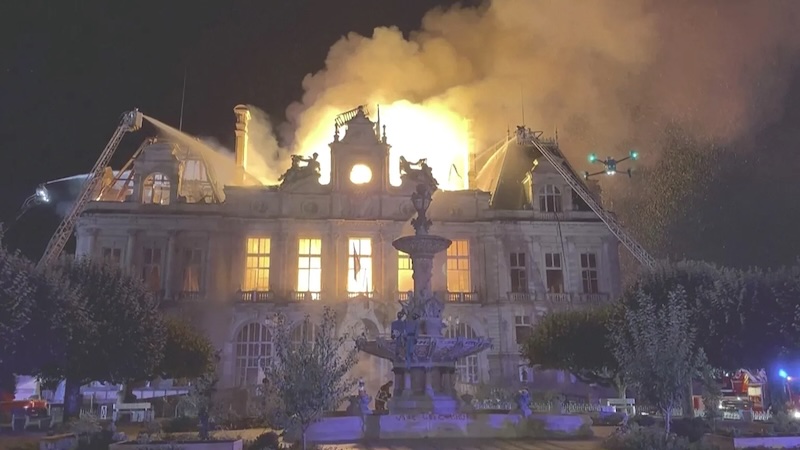
The town hall of Limoges was entirely destroyed by an arson fire on Saturday, October 17, 2026, during the protests.
They burned it down, in a few hours, on October 17, the Town Hall of Limoges went from the status of a recently restored monument to that of a smoking ruin. The bell tower collapsed, the roof gave way, and a large part of the façade disappeared. The prefect of Haute-Vienne, Maurice Barate, spoke of a “heritage catastrophe” and a “deliberate act of vandals.” The mayor, Guillaume Guérin, described the attack as “abject” and “hateful.” Elected officials, municipal police officers, and staff were inside. No one was injured. The building, however, is largely lost.
Things to discover
How the fire started. The Limoges protest, which gathered several thousand people as part of the national mobilization against the “high cost of living,” remained mostly calm for much of the day. It was at the end of the march that the shift occurred.
Hooded individuals first burned municipal police vehicles on the forecourt of the Town Hall. Then they broke the windows on the ground floor, forced the entrance, and set fire to the inside. The flames spread rapidly to one wing, reaching the framework and the roof. The wind worsened the situation.
In a few hours, the bell tower collapsed and two-thirds of the façade were swept away. The prefect insisted: it was not the work of the protesters, but a deliberate act of vandals. Some images and testimonies mention incendiary devices thrown inside, including Molotov cocktails.
The investigation, opened for willful destruction, will need to clarify the exact means used and identify the perpetrators. Businesses in the city center were also looted in the aftermath.
The town hall of Limoges was not just any building
Inaugurated on July 14, 1883, it was designed by Charles-Alfred Leclerc, architect of the palaces of Versailles, in a neo-Renaissance and Louis XIII style inspired by the City Hall of Paris, largely financed by the bequest of Alfred Fournier, it featured on its façade the allegories of goldsmithing and enameling, as well as the medallions of illustrious Limougeauds. Classified as a historical monument in 1975, it dominated the square with its 43-meter bell tower.
A restored fountain of the Arts of Fire preceded it. The Limougeauds had restored its luster between 2019 and 2022, the façades had been cleaned, the woodwork restored or replaced, the sculptures refurbished, and the lighting renewed. An appeal to the Heritage Foundation had been launched. The town hall shone once again.
It became, in one evening, the most visible symbol of October 17. Across France, the mobilization gathered between 550,000 and 800,000 people, according to the organizers. In many cities, the processions were diverted by violent groups. In Limoges, the result is clear: a recently restored historical monument was deliberately set on fire while people were still inside.
This is not an accident, it is the result of a failure of authority.
A mobilization was announced, the excesses were predictable, and the law enforcement was overwhelmed.
The Macronist state, which promised to “stand firm against the sowers of chaos,” did not prevent vandals from invading a public building and starting an arson fire. The president promised prosecutions. The Limougeauds, however, saw their heritage go up in smoke. Public service continues, the mayor said. The monument does not.
The Town Hall of Limoges is no longer just the 19th-century building that symbolized local Republic. It has become, through fire, the symbol of this October 17, that of a diverted anger, of an authority that yields, and of a heritage that burns before the eyes of those who were supposed to protect it.
We cannot pretend that nothing happened.
The editorial team recommends
Fancy reading all the articles?
Unlock all articles straight away. No obligation.