From November 13 in Paris to October 23 in Trappes: where has the Nation gone?
Once a national catharsis, the terrorist ordeal has become the ground for an internal war and a collective self-flagellation. From defining terrorism as a national catharsis to an essentialized terrorism.
By Miriam Djabali Larak (*)
Published on 13 November 2026
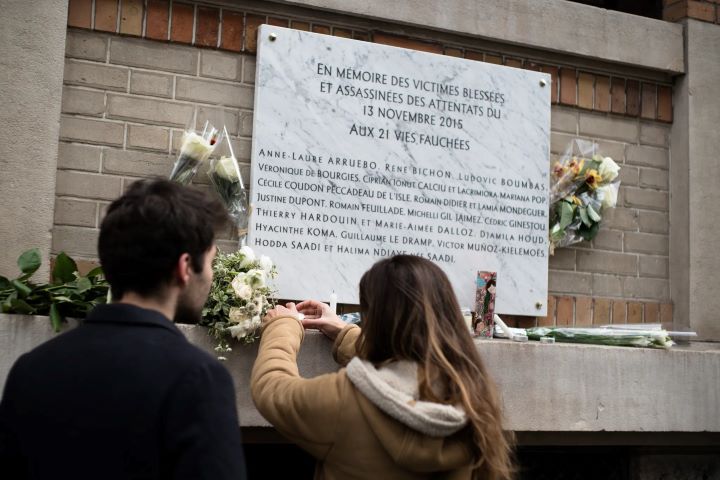
November 13 is no longer just a simple date on a list.
We will no longer remember November 13 as the day of the first collective exhibition of surrealists in Paris in 1925, nor as the date of the first flight of a helicopter in 1907 or the Nobel Prize awarded to André Gide in 1947. The cultural radiance of France in Paris has given way to a day of national mourning in memory of 132 victims, the heaviest toll in the history of contemporary terrorism on our soil.
But collective memory is maintained and reinvented. As Queen Elizabeth II had wryly put it in response to Meghan Markle’s accusations: “Some recollections may vary” — some memories may differ. November 13 is no longer just a simple date on a list: when terrorism no longer unites France but divides it. It adds to a long tragic litany: March 2012 in Toulouse and Montauban, January 2015 at Charlie Hebdo and the Hyper Cacher, July 2016 in Nice, December 11, 2018 in Strasbourg, October 16, 2020 in Conflans-Sainte-Honorine, October 29, 2020 at the Notre-Dame Basilica in Nice, October 13, 2023 in Arras, up to October 23, 2026 in Trappes and La Verrière. Alongside the official victims, there is now an army of the living dead, collateral victims of these repeated assaults on our cultural identity, our youth, our schools, and our way of life.
Yet, something fundamental has broken in our relationship with the tragic. Once, terrorism acted as a national catharsis. In the face of barbarism, the country stood united in a unanimous and magnanimous communion. Terrorism was self-sufficient: it brought everyone together and did not divide.
Today, with the attack in Trappes on October 23, the public debate is lost and fractured. We discuss racism more than terrorism, as if individual motivation should overshadow the absolute nature of the crime. Some even go so far as to be outraged when we remind them of an obvious truth: terrorism does not take on adjectives. By wanting to reduce it to a simple racial motive, we confuse the supreme criminal qualification (Article 421-1 of the Penal Code, which punishes attacks on the Nation as a whole) and the aggravating circumstance of racism (Article 132-76). By its total nature and its will to annihilate the other, the terrorist enterprise absorbs and transcends particular hatreds.
To discuss today the hierarchy between the racist nature and the terrorist nature of the Trappes attack is therefore a legal and epistemological nonsense that leads to a dangerous sociologization of the law. This semantic quarrel only serves the political aims of a far-left movement that thrives on the fragmentation of society, the competition of memories, and a form of collective self-flagellation. There are moments when politics must regain a sense of decency and where manipulation must fade away. Terrorism is self-sufficient: it must unite and bond the Nation, never serve as an instrument of blackmail or internal division.
M. Dj. L.
(*) Professor of economics and observer of public life
The editorial team recommends
Fancy reading all the articles?
Unlock all articles straight away. No obligation.