François Fillon in Le Mans: “The fate of Christians in the East is the prelude to our own fate”
François Fillon's conviction is simple and radical: there will be no lasting peace in the Middle East without the preservation of the cultural and religious diversity that has fertilized these lands since the origins of the modern era.
Published on 30 October 2026
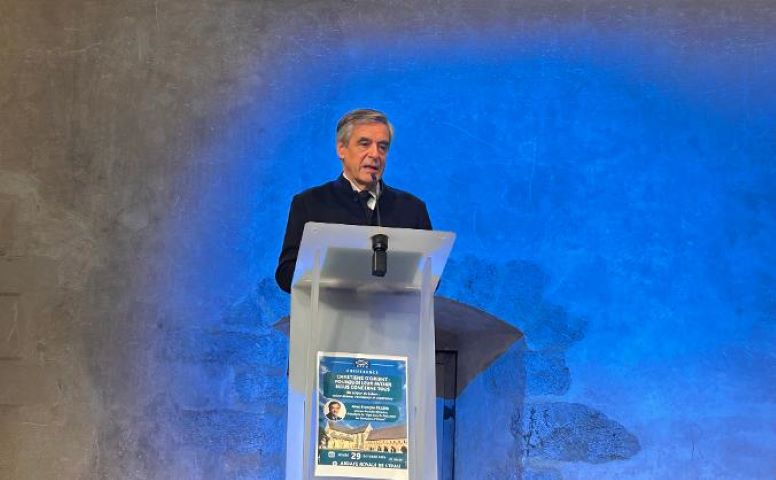
François Fillon expands the discussion to the Sahel, which he cites along with Nigeria.
© Rupture
Le Mans. On Thursday evening, October 29, at the royal abbey of l’Épau, François Fillon defended before the association Les chrétiens d’Orient.
We must define the Christians of the East. Christians have always lived in the Middle East (Egypt, Lebanon, Syria, Iraq, Palestine, Jordan). Christianity was born there, in Palestine, around Jerusalem, in the 1st century. These communities are the direct descendants of the first Christians. They existed long before the arrival of Islam in the 7th century.
Things to discover
They are not a single homogeneous group. There are several different Churches: the Copts in Egypt (the most numerous), the Maronites in Lebanon, the Assyrians/Chaldeans and the Syriacs mainly in Iraq and Syria, the Greek Orthodox, the Armenians.
After the Muslim conquest
Between the 7th and 8th centuries, the Muslim conquest absorbed the original heart of Christianity (Egypt, Syria, Mesopotamia, Jerusalem in 638). Christians became minorities (dhimmi status), but did not disappear. They retained their languages, rites, and ecclesiastical structures throughout the successive empires (caliphates, Byzantium, Ottoman). Christian Arab tribes (Ghassanids, Lakhmids) already existed before Islam.
They are the direct heirs of the first Christian communities born on the very land of Christ and the apostles, who have survived for two millennia.
Today, they are minorities (about 10-15 million in the region), often threatened or in sharp decline due to conflicts and emigration.
François Fillon’s conviction is simple and radical: there will be no lasting peace in the Middle East without the preservation of the cultural and religious diversity that has fertilized these lands since the origins of the modern era. Three priorities structure the association’s action: raising awareness among governments and public opinion in France, Europe, and the Middle East; supporting field actions focused on education, reconstruction of schools, scholarships, vocational training, promotion of women, and assistance with resettlement through partners like l’Œuvre d’Orient; finally, conducting emergency humanitarian actions, food and health-related, without distinction of faith.
François Fillon made a blunt observation: “Almost everywhere in the Middle East, there is a real effort to eliminate them from the region.” He pointed to Syria, where Christian, Kurdish, and Alawite minorities are “hunted, imprisoned, tortured,” despite the seemingly friendly relations between European capitals and Damascus. In February, after a meeting with Monsignor Audo, Chaldean Bishop of Aleppo, he called on the French government to reopen the French high school in Aleppo, closed since the beginning of the civil war, and stated that the defense of Christians in the East “must be a prerequisite for any cooperation with the Syrian regime.”
In July, upon returning from a stay in Lebanon where he met with Maronite Patriarch Raï in the Holy Valley and served six thousand meals to the most disadvantaged in the South, he described Lebanon as a “unique model” of coexistence, while warning of an external conflict that risks “dislocating fragile balances” and the “ongoing eradication” of ancient villages in the South. His call: “France and Europe must not accept” this disappearance.
The figures of decline
Demography supports the urgency. In the seventh century, in the Middle East, Christians made up 95% of the population. Today, they represent about 3% of all populations in the Middle East and North Africa, down from 13.6% in 1910. By country, the situation is dramatic for Christians.
Turkey has fallen from 19% to 25% of Christians in 1914 to 0.3% today, with 33,000 Catholics according to the Vatican.
Lebanon, once at 77.5%, is now around 32%, with some estimating it as low as 19%, with no census since 1932. Southern Lebanon, bordering Israel, where many Christian villages are particularly endangered, is caught between Israeli strikes on Hezbollah and vice versa, with Israel effectively creating a buffer zone but to the detriment of Eastern Jews.
Iraq has fallen from 1.2 million Christians in 2003 to between 150,000 and 30,000. Syria has lost 80% of its Christian community in fourteen years, with only 3,000 to 4,000 remaining, compared to one and a half to two and a half million before the war.
Open Doors ranks Syria as the sixth country for Christian persecution in the world in 2026, down from eighteenth the previous year. In Jordan, Christians are protected thanks to the king’s actions; they make up 2% of the population, and some participate in the government despite the attack on October 23, where 9 faithful were killed in an attack in Karak.
In Palestine, there is 1% of Christians. In Bethlehem, where there were 86% Christians in 1950, there are now only 10%. Gaza has fallen from about 150,000 Christians to fewer than 600.
Only Egypt sees its Christian population stable at 18%, with nine million people.
Israel, with 184,000 Christians, is up 0.7% and escapes collapse.
The Sahel, new epicenter of Christian persecution
François Fillon expands the discussion to the Sahel, which he cites along with Nigeria. The report from Aid to the Church in Need published last Tuesday, “Persecuted and Forgotten?”, lists two hundred twenty million Christians exposed to persecution worldwide. Six of the ten countries most affected by terrorism are African: Burkina Faso, Niger, Nigeria, Mali, Somalia, and the DRC. In Burkina Faso, jihadist groups control at least forty percent of the territory; twenty-six men were beheaded in the diocese of Nouna.
In Mali, eight hundred sixty-seven thousand Christians live under threat. At least one hundred churches and Christian schools were destroyed in 2025, religious taxes imposed, forced conversion or exile as the only options. In Niger, three hundred fifteen students and staff of the Sainte-Marie boarding school were kidnapped last November. In Nigeria, three thousand eighty-three Christians were killed and three thousand one hundred ninety-three kidnapped between January and August 2026.
“It is not good to be a Christian in the land of Islam”
Fillon’s consistent thread since his speech in the Senate in December 2019 is: “The fate of Christians in the East is the prelude to our own fate.” He will also say: “It is not good to be a Christian in the land of Islam.”
His thesis: their disappearance heralds a violent confrontation between Europeans and the Muslim world, which is traversed by a totalitarian current. Hence his demand for a united and uncompromising Europe, and his reminder that France has a historical debt to these communities.
The editorial team recommends
Fancy reading all the articles?
Unlock all articles straight away. No obligation.