Legislative elections in Israel: neither the Netanyahu nor the Eisenkot blocs have a majority, the Arab parties in a position of “kingmakers”
Israel is still at an impasse more than 24 hours after the polls closed. With about 90% of the ballots counted, the votes of soldiers, diplomats, and other "double envelopes" are still being tallied, with no major upheaval expected. Benjamin Netanyahu's bloc is still in the lead with 53 seats, compared to 48 for his opposition rival Gadi Eisenkot. Neither bloc has an absolute majority in the Knesset. A record score has been recorded for the Arab parties, with a projection of 19 seats.
Published on 29 October 2026
What are the possible scenarios in Israel after legislative elections with no real winner?
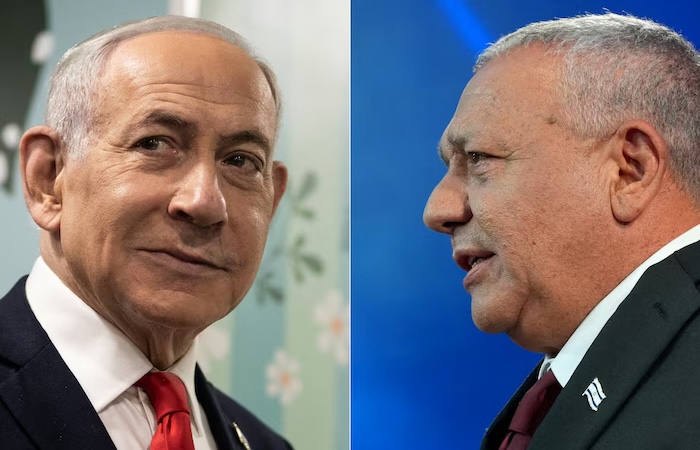
The legislative elections of October 27, 2026, the first since the attacks of October 7, 2023, and the subsequent wars in Gaza, Lebanon, and with Iran, did not yield a clear winner. With about 90% of the ballots counted, the votes of soldiers, diplomats, and other “double envelopes” still being counted without major upheaval expected, Benjamin Netanyahu’s bloc is credited with about 53 seats out of 120 in the Knesset, the opposition bloc led by Gadi Eisenkot (Yashar) with about 48, and the Arab parties with a record of 19 seats. No camp reaches the 61 seats necessary for a majority.
Things to discover
The voter turnout reached 77.7%, its highest level since 1999, with particularly strong mobilization in Arab localities. Netanyahu’s Likud remains the leading party (around 26-27 seats), followed by Eisenkot’s Yashar (around 21). The outgoing bloc, which had a comfortable majority (around 64-68 seats), has significantly declined.
Eisenkot, former chief of staff of the army, created his party in 2025 and campaigned on the security failures of October 7, the need for an inquiry commission, national service for all (including ultra-Orthodox), and a firm security line, without paving the way for a Palestinian state.
An arithmetic blocked by red lines
On paper, the anti-Netanyahu forces (the Eisenkot bloc and the Arab parties) total about 67 seats. But the Israeli political reality makes this theoretical majority difficult to transform into a government. Most Jewish opposition parties (Bennett, Liberman, and Eisenkot himself in his initial statements) have excluded forming a formal coalition with the Arab parties, which they consider anti-Zionist.
The Arab parties (United List and Ra’am of Mansour Abbas), bolstered by a rejection vote against the government and its far-right allies, say they are ready to help bring down Netanyahu, possibly in external support, but not necessarily to join an executive.
Netanyahu, for his part, claims a “clear majority among the Zionist and Jewish public” and refuses any government supported by the Arab parties. He remains the acting Prime Minister during the negotiations. President Isaac Herzog has already called on the parties to do everything possible to avoid a new election.
This election took place in the trauma of October 7 and the wars that followed. Critics pointed to the lack of an independent inquiry commission into security failures, the refusal to lift military exemptions for ultra-Orthodox while the army is short-staffed, the cost of living, Netanyahu’s corruption trials (which he denies), and the nationalist-religious shift of the outgoing government.
Netanyahu highlighted military successes and the prospect of coordinated actions with the United States against Iran. Eisenkot emphasized the loss of trust in the government since October 7 and the need for a “responsible Zionist government”.
What are the possible scenarios in Israel after legislative elections with no real winner?
After the official proclamation of results by Thursday evening or Friday morning, the Israeli president, Isaac Herzog, will task the candidate deemed best placed to gather at least 61 deputies to form a government.
Netanyahu or Eisenkot would attempt to build a majority by attracting one or more opposition parties (or part of them) on security or national service bases. If the Likud, the Prime Minister’s party, is once again the party with the most seats, it seems difficult for the outgoing government leader to find support beyond his allies with whom he formed the government.
Eisenkot is attempting a minority or support formula with the Arab parties, which requires crossing historic red lines and risks significant instability.
Failure of negotiations and a return to the polls, with Netanyahu remaining in place as transitional Prime Minister, with limited but real powers over security issues.
The result confirms both Netanyahu’s political resilience, which has withstood better than predicted by exit polls, and the deep fragmentation of Israeli society. The rise of the Arab parties makes them potential kingmakers, but the taboo surrounding them in most Jewish forces keeps the country in a structural impasse.
The coming weeks will be decisive for either an unprecedented compromise to form, or Israel to prepare for a new election in an ongoing war context.
The editorial team recommends
Fancy reading all the articles?
Unlock all articles straight away. No obligation.