Legislative elections in Israel: With 84.66% of the ballots counted, Netanyahu’s bloc is in the lead, but the Eisenkot list is making progress.
We are about to reach the end of the suspense. It is likely that Netanyahu's bloc is neck and neck with the Eisenkot bloc in the final result. Most of the Arab votes have already been counted, so we can expect a relatively marked decrease on that side. With 84.66% of the ballots counted, the pro-Netanyahu bloc has 54 seats, the bloc led by Eisenkot has 49, and the Arab parties have 17.
By Karim Maloum
Published on 28 October 2026
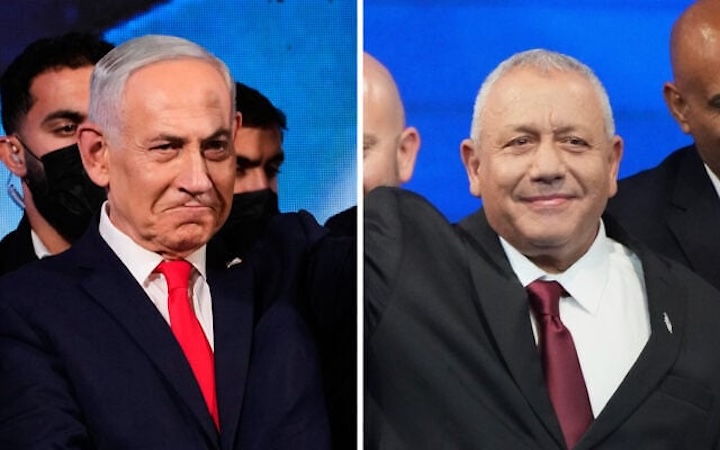
About 600,000 double-envelope ballots still need to be counted, according to an estimate from the Central Election Commission reported by Israeli media. Their counting may not be completed until Friday.
A minority government, a unity government, or new elections: 3 post-electoral scenarios. As more than 84% of the votes have been counted the day after the elections in Israel, Prime Minister Benjamin Netanyahu’s bloc totals 54 seats, which is two less than in the previous preliminary results, still remaining below the 61 seats needed to achieve a majority.
Israel is entering a zone of political disturbances. The balance of power within the new Knesset, the unicameral Israeli parliament with 120 elected members, is expected to evolve further as the counting progresses, but victory now seems out of reach for the Eisenkot bloc, which was neck and neck with Netanyahu’s camp in pre-election polls.
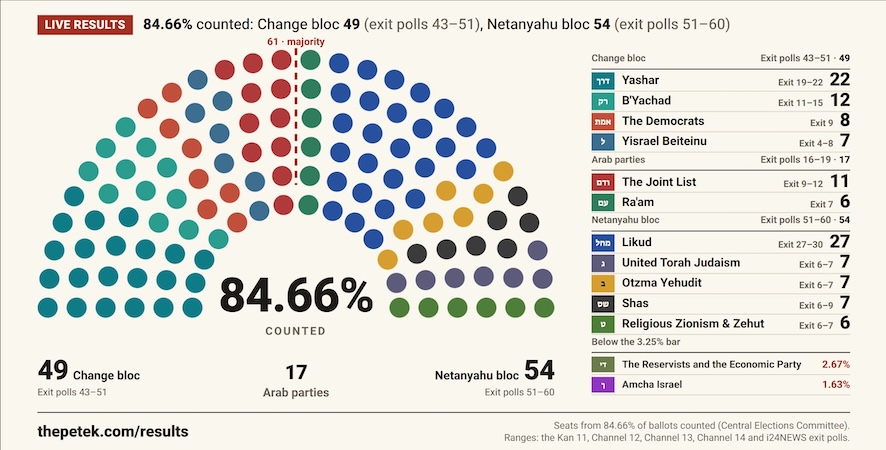
The opposition bloc, led by centrist Gadi Eisenkot, would obtain 49 seats. The Arab parties, which until now could hope to obtain 19, are declining and should – at this stage – send between 15 to 16 representatives to the Knesset.
Most of the Arab votes have already been counted, so we can expect a relatively marked decrease on that side.
These partial results are likely to vary greatly, with several exit polls showing the camps neck and neck and without a parliamentary majority. Voter turnout reached 77.7%, its highest level since 1999. This is the first national election since October 7, 2023.
About 600,000 double-envelope ballots still need to be counted
The leader of the Arab party the Joint List, currently strong with 17 seats, calls for a coalition to oust Benjamin Netanyahu and his “bloody government.” “We are ready to pave the way for the removal of the Netanyahu government and its dismissal,” said Yousef Jabareen on Channel 13. “It is either the persistence of racism, exclusion, and supremacy, or a true Jewish-Arab partnership,” he asserted.
The Israeli elections could be influenced by the use of double-envelope ballots, which could further alter the distribution of seats.
These results are partial and will evolve as the counting continues. The ballots cast in double envelopes, including those from soldiers, will be counted later.
About 600,000 double-envelope ballots still need to be counted, according to an estimate from the Central Election Commission reported by Israeli media. Their counting may not be completed until Friday.
These votes mainly come from military personnel, but also from detainees, medical staff, and Israeli representatives abroad. With about 40,000 votes needed to obtain a seat, they could change the balances in the Knesset.
No bloc thus reaches the 61 seats necessary to secure an absolute majority in the Knesset, the Israeli Parliament. This morning, it can be said that Netanyahu has lost, but the opposition has not won.
The editorial team recommends
- The Israeli electoral system: how it works
- Legislative elections in Israel: Benjamin Netanyahu’s camp leads after 50% of the ballots counted, according to the Electoral Commission.
Fancy reading all the articles?
Unlock all articles straight away. No obligation.