Legislative elections in Israel: Gadi Eisenkot, who has taken the lead of the anti-Netanyahu movement, is neck and neck in the polls with the current coalition, including Likud.
On October 27, more than 7 million Israelis are called to the polls to elect the 120 members of the Knesset, a pillar of the country's political system. The outgoing Prime Minister Benjamin Netanyahu is aiming for a seventh term in the first election since October 7 and continues to present himself as the only one capable of ensuring the security of the inhabitants of the Jewish state. The latest polls show that Gadi Eisenkot, the former general of the IDF who has taken the lead of the anti-Netanyahu camp, is neck and neck with Netanyahu's Likud party.
By Karim Maloum
Published on 26 October 2026
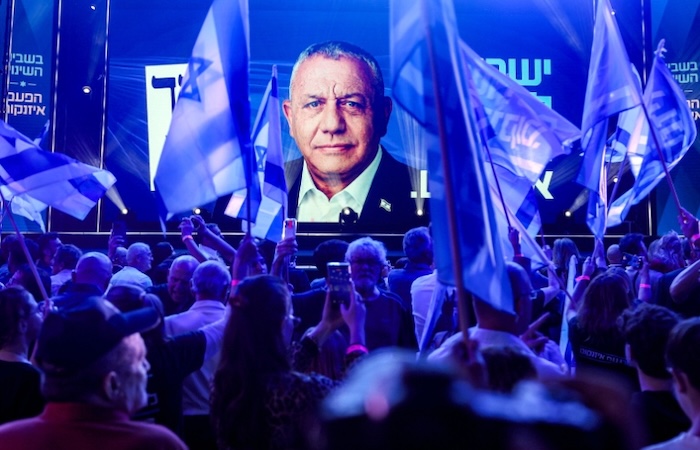
A meeting of Gadi Eisenkot in Tel Aviv on October 25, 2026.
Two days before the Israeli legislative elections, outgoing Prime Minister Benjamin Netanyahu is aiming for a seventh term in the first election since October 7. This legislative election, the first since 2022, resembles a referendum on the future of the Prime Minister.
He may be the next Prime Minister of Israel. The former chief of staff, whose bloc is neck and neck with that of Benjamin Netanyahu, held a final meeting in front of several hundred supporters gathered in Tel Aviv.
However, Benjamin Netanyahu is challenged by a former chief of staff, Gadi Eisenkot. He may be the next Prime Minister of Israel. The former chief of staff, whose bloc is neck and neck with that of Benjamin Netanyahu, held a final meeting in front of several hundred supporters gathered in Tel Aviv, who promised on Sunday, October 25, to reconcile a deeply divided country, while his rival, the current Prime Minister, intensified attacks against the opposition, accusing it of complacency towards Iran and the Palestinians.
A position weakened by the failure of October 7 and reports that the United Arab Emirates and Egypt had personally informed him. Was the Israeli Prime Minister warned of the risks of an attack by Hamas before October 7, 2023?
An investigation published on Tuesday, September 8, by the daily Haaretz reveals that Benjamin Netanyahu kept to himself a major alert from Emirati President Mohammed bin Zayed about a large-scale Hamas attack 10 days before the terrorist attacks of October 7, 2023. His office categorically rejects the accusation, while his opponents demand accountability.
Israelis are going to the polls for the first time since the Hamas terrorist attacks, which resulted in 1,221 deaths, 251 hostages taken to the Gaza Strip, and plunged the country and the entire Middle East into the chaos of war. Like previous elections, the electoral campaign has been centered on the figure of the outgoing Prime Minister, Benjamin Netanyahu. He is seeking a seventh term, having already held this position from 1996 to 1999 and almost uninterruptedly since 2009.
How does the Israeli electoral system work?
In Israel, legislative elections are held every four years. The 120 members of the Knesset (the “Parliament” in Hebrew) are elected by proportional representation: seats are allocated based on the number of votes received. To enter, a list must obtain at least 3.25% of the votes cast, a particularly low eligibility threshold.
All Israeli citizens aged at least 18 on election day and registered on the electoral rolls have the right to vote, explains The Jerusalem Post. There are more than 7.3 million of them, including over 500,000 potential first-time voters, accounting for more than 8% of the electorate.
However, Israelis can only vote on national territory, with a few exceptions. Officials and diplomats stationed abroad began voting on October 15. Military personnel on missions outside the country will be able to vote starting October 20, as in previous elections.
An Israeli of voting age living abroad – estimated to be around 500,000 – must therefore travel to Israel to participate in the election unless they fall under one of these exceptions.
The 120 seats are proportionally distributed based on the results obtained by each list across the country – a system called “full proportional representation.”
In 2022, the Likud list led by Benjamin Netanyahu came in first but only secured 32 seats. To govern, he allied with supremacists and ultra-Orthodox parties to reach 64 seats. Thus, coalition-building is essential despite the political instability it induces. Between 2019 and 2022, the country, mired in a political crisis, experienced five different governments.
Fancy reading all the articles?
Unlock all articles straight away. No obligation.